
Infertility is a critical issue affecting billions of couples globally, encouraging diligent work in reproductive medicine and boosting options for different pathways in conception. Intracytoplasmic Sperm Injection, popularly known as ICSI, is one of the important inventions available in assisted reproductive technology. ICSI is a specific fertility procedure used in conjunction with In Vitro Fertilization (IVF) to provide positive outcomes in the process of successful fertilization.
When couples who are interested in fertility treatment and IVF hear about ICSI, they ask the question: What is ICSI, and why is it used with IVF? To enhance their treatment knowledge, couples must start with the process of ICSI, including its success rate and the profile of candidates who are most likely to benefit from the process.
In this guide, we analyse the structure of ICSI and provide both the specialists’ and patients’ insights about the procedure as well as the potential of ICSI to enhance outcomes of IVF.
What is ICSI?
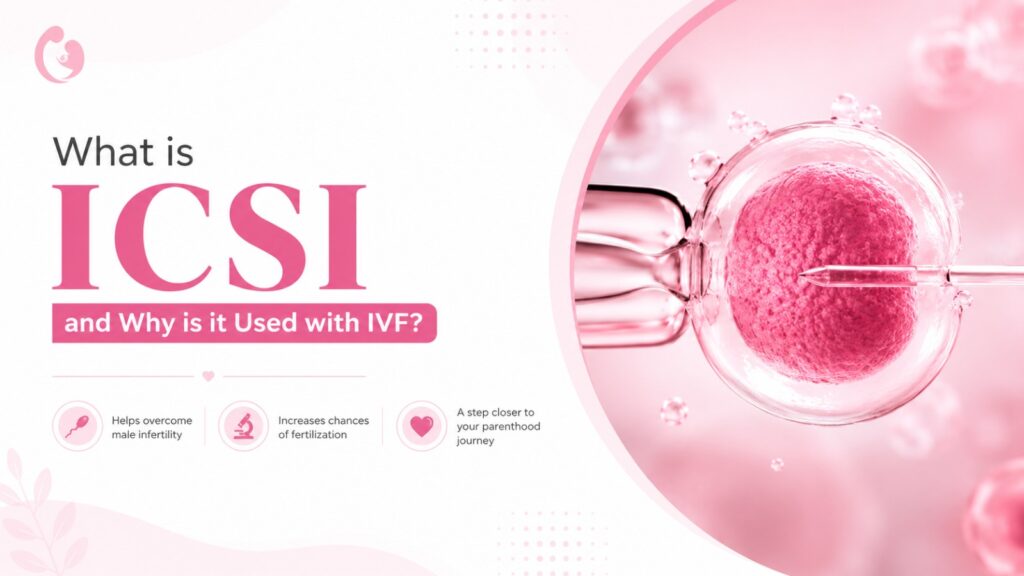
ICSI means Intracytoplasmic Sperm Injection and refers to a complex laboratory process during IVF. In the context of this process, a fertility specialist employs his knowledge and skills to use a microscopic needle to inject a healthy sperm directly into a mature egg.
In comparison to conventional IVF, which places both the sperm and the eggs in a sterile glass culture dish to provide the fertilization process, ICSI circumvents numerous obstructions that inhibit fertilization from occurring naturally.
The procedure was originally designed to address male infertility problems, but currently can be used for other infertility problems as well.
How Does ICSI Work With IVF?
ICSI is a technique of the IVF process and works as follows:
1. Ovarian Stimulation
The female partner is given medication to assist in developing multiple mature eggs.
2. Egg Retrieval
After the eggs mature, the fertility doctor performs a simple surgical procedure to remove the eggs.
3. Sperm Collection
The male partner or donor provides a semen sample. The laboratory selects the healthiest sperm for the procedure.
4. Sperm Injection
With the use of very precise and powerful microscopes, the embryologist performs the technique of injecting individual sperm into each of the mature eggs.
5. Fertilization Monitoring
The eggs are cultured in the laboratory and monitored for fertilization.
6. Embryo Development
The fertilized eggs develop into embryos in the laboratory.
7. Embryo Transfer
The embryos are then placed into the uterus, which helps to establish a pregnancy.
Why is ICSI Used With IVF?
ICSI is preferred when there is a greater concern of treated fertilization with traditional methods of IVF.
Doctors may advise the use of ICSI when they believe that there is a circumstance in which the sperm may not be able to breach the outer layer of the egg in the same way that it may occur naturally.
Here are the most common reasons why ICSI is advised with IVF.
Male Factor Infertility
Male Factor Infertility is one of the main reasons why doctors suggest ICSI. Issues associated with sperm count, sperm motility, and sperm shape can all contribute to the likelihood of a successful pregnancy being reduced.
Some of the Common Issues Associated with Male Infertility and the Use of ICSI
– Low sperm count
– Slow or Poor sperm motility
– Abnormally shaped sperm
– Blocked passageways for the sperm in the Male Reproductive System
– Disorders of Ejaculation
– Sperm that is Retrieved Surgically for the Male
In these scenarios, the successful completion of the fertilization process is significantly improved with the use of ICSI.
Who is a Good Candidate for ICSI?
ICSI is appropriate for people with:
– Absence of sperm in ejaculate
– Low sperm count
– Poor sperm quality
– Failed fertilization in previous IVF cycles
– Natural antigen refractoriness to sperm
– Use of frozen sperm or eggs
– Surgical sperm extraction
– Unexplained infertility
– Requirement of genetic testing
The use of ICSI is a decision jointly made by the fertility specialist and the couple after careful consideration of the female age and reproductive history, and the results of the fertility assessment of both the male and the female.
ICSI has several great advantages.
Higher Fertilization Rates
ICSI, in cases of severe male infertility, greatly increases the likelihood of successful fertilization.
Helps Overcome Male Infertility
In such instances, even men with an extremely low sperm count are able to achieve their goal of becoming biological fathers.
Lower Fertilization Failure Risk
Sperm failing to penetrate the egg is rare with ICSI.
Benefit of Surgically Retrieved Sperm
ICSI provides good opportunities for men with blocked sperm ducts or men with azoospermia to achieve conception.
Enhances Genetic Testing
ICSI makes genetic testing of embryos more reliable.
Success Rate of ICSI
ICSI is associated with high fertilization rates. However, there are still a number of factors to be considered when evaluating the actual likelihood of achieving a clinical pregnancy.
Factors Impacting ICSI Success
– Female Age
– Quality of the Oocyte
– Quality of the Sperm
– Quality of the Embryo
– Quality of the Uterus
– Specialization of the Fertility Center
– Type of Infertility the Patient Has
Typically, fertilization takes place in roughly 70% to 85% of the eggs that undergo ICSI, but the likelihood of achieving a clinical pregnancy is much lower. Generally, women younger than 35 years have higher rates of successful IVF and ICSI than older women.
Typical IVF With ICSI Timeline
1. Fertility testing and consultation
2. Ovarian stimulation (10–14 days)
3. Egg retrieval
4. ICSI fertilization
5. Embryo culture (3–5 days)
6. Embryo transfer
7. Pregnancy testing
What is the Cost of ICSI?
Pricing for ICSI varies based on:
– Country
– Fertility clinic
– Medication requirements
– Laboratory technology
– Other procedures
Costs of ICSI typically get added to the overall costs of standard IVF treatment.
In India, pricing of ICSI treatment is often moderate to premium, depending on the clinic’s experience and the complexity of the treatment.
Patients should receive a quote for the detailed treatment plan prior to commencement.
Improving the Probability of IVF Success
Patients can empower their reproductive health by undertaking the necessary lifestyle changes.
Fertility Favours
– Maintain a healthy weight
– Avoid smoking and drinking
– Follow a healthy balanced diet
– When necessary, receive a fertility friendly supplement
– Follow prescribed medications
– Work with a qualified professional and a fertility friendly supportive environment
There are never guarantees when improving the chances of becoming pregnant through a lifestyle change, there is always the possibility of improved outcome results.
CONCLUSION
The invention of ICSI is one of the most recognisable milestones in the innovation of modern fertility treatment. The ability to insert a sperm cell directly into an ovum to facilitate fertilization through targeted IVF treatment has enabled many couples to manage their male infertility and other associated issues.
Patients who have been diagnosed with having a low sperm count, poor sperm motility, a prior failed IVF treatment and/or unexplained infertility are likely to have a successful outcome from IVF treatment using ICSI.
Although ICSI is beneficial, it is important to note that every fertility journey is different. It is recommended that couples have a private consultation with a fertility specialist in order to develop a unique and effective reproductive solution to their needs.
Innovative reproductive techniques and technologies will continue to bring relief to many couples who yearn to have children.
FAQs
It is generally accepted that ICSI is not painful because the procedure is performed on an egg outside of the body. Mild discomfort may be involved in some steps of the IVF cycle like egg retrieval.
No fertility procedure is a guarantee for pregnancy. ICSI may increase the rates of fertilization, but the implantation and pregnancy are not determined with the same certainty.
Most babies that are born post-ICSI are generally healthy. The fertility specialists have ensured that the patients are monitored consistently, and this helps in mitigating the risks.
Yes, ICSI addresses the issue of low sperm count and low sperm motility.