
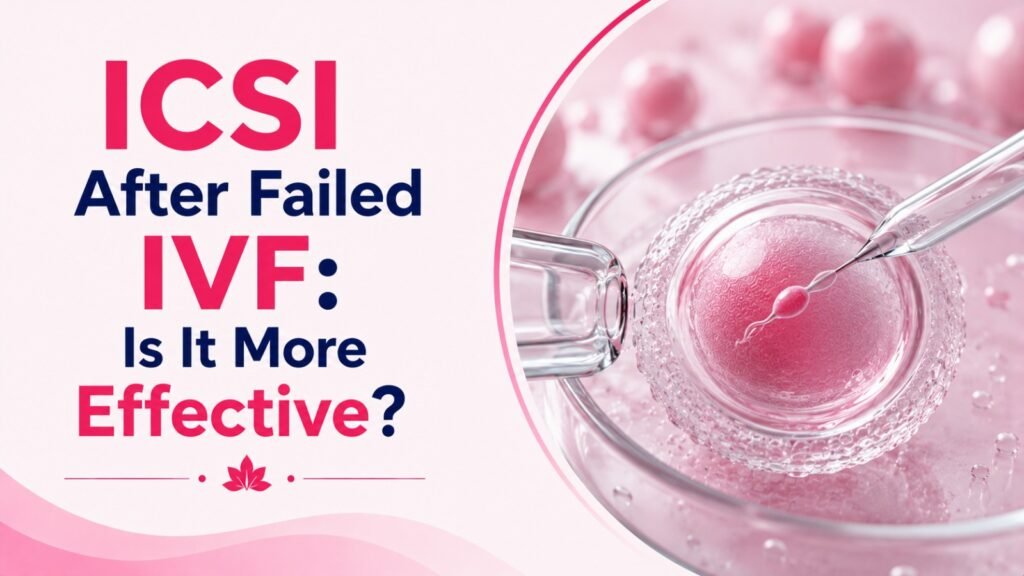
Going through IVF (In Vitro Fertilization) and not achieving a pregnancy can be emotionally draining, and for many couples, a failed IVF cycle prompts the search for alternative fertility options. An alternative that many doctors first recommend is ICSI (Intracytoplasmic Sperm Injection).
The pressing question though is, is ICSI after failed IVF more effective?
That answer is dependent on why the IVF cycle failed in the first place. While ICSI improves fertilization for certain types of infertility, it is not the answer for everyone, and having the knowledge of the way ICSI functions, the reason it is used, and its success rates can help couples determine next steps with their fertility specialist.
In this guide, we cover the advantages of ICSI after failed IVF, the success rates and who it may be appropriate for and the variables that affect success.
Understanding IVF and Why It Can Fail
Before moving on to ICSI, it is important to know the reason(s) IVF may fail.
In traditional IVF, eggs that have been collected and sperm that have been processed are placed in a lab dish together.
Describing fertilization is easy. Natural fertilization happens when one sperm penetrates one egg.
There are many possible barriers that may cause fertilization or implantation to be unsuccessful. These include:
- Implantation failures
- Poor egg or sperm quality
- Failed fertilization
- Developmental errors of an embryo
- Chromosomal abnormalities
- Uterine abnormalities
- Hormonal imbalances
- Maternal age
A failed IVF cycle does not guarantee that the following cycles will be unsuccessful. Fertility specialists will use the first IVF cycle to understand the case better and will use this information for the subsequent cycles.
ICSI
Intracytoplasmic Sperm Injection (ICSI) is a technique that is used when IVF is performed to enhance the fertilization of the egg.
ICSI is a technique where a single sperm is injected into one egg using a very fine needle, as opposed to allowing natural fertilization to occur.
Once fertilization is achieved, the embryo is transferred to the uterus after a period of time in the lab where it is allowed to develop.
Although ICSI was first designed for treatment of a certain type of male infertility, it is now a very popular ART.
Can ICSI Increase the Chances of Successful IVF After IVF Failure?
In numerous cases, the answer is yes.
ICSI is helpful, especially when the previous IVF cycle failed due to the absence of fertilization or very low fertilization rates.
In cases of:
– Complete absence of fertilization
– Poor sperm motility
– Low sperm count
– Abnormal sperm morphology
– Frozen sperm
– Surgically extracted sperm
– Unexplained infertility with unsuccessful previous IVF
ICSI can enhance the chances of successful fertilization; however, if the IVF failed due to insufficient quality of the embryos, failure of implantation, or issues with the uterus, ICSI may not significantly increase the chances of pregnancy.
So, before deciding to use ICSI, the reasons for the IVF failure need to be clearly established.
When do Fertility Experts Suggest ICSI After IVF Failure?
If the reason for IVF failure is establishment of fertilization and key laboratory findings point to fertilization, ICSI is usually suggested after the first or more failed IVF attempts.
Common examples include:
1. Previous Failure of Fertilization
If none of the eggs have fertilized in classical IVF, ICSI is usually a favoured option in the next attempt.
This is one of the biggest reasons for ICSI.
2. Low Rate of Fertilization
In some cases, only a small percentage of the eggs have been fertilized.
In the next attempts, ICSI can provide a better rate of fertilization.
3. Severe Male Infertility
In cases of very low sperm count, very poor sperm motility, obstructive azoospermia, or non-obstructive azoospermia with sperm extraction, ICSI is the preferred option.
4. Unexplained Infertility
If all fertility evaluations are normal and there are still multiple unsuccessful IVF cycles, doctors may suggest ICSI to address possible issues with fertilization.
5. Frozen Eggs
Freezing eggs may cause a slight hardening to the outer shell of an egg.
ICSI increases the chances of fertilization for thawed eggs.
Success Rates of ICSI After Failed IVF
Success rates for ICSI post-failed IVF cycles are complex and are reliant on a multitude of factors. Some key factors include:
– Age of the woman
– Quality of the egg
– Quality of the sperm
– Total number of embryos
– Quality of the embryos
– Quality of the endometrium
– Quality of the laboratory work
– Nature of the infertility issue
ICSI generally has a fertilization rate of around 70-80% for mature eggs. Statistics of pregnancy focus on embryo implantation and the normal progression of pregnancy. For couples who have had unsuccessful fertilization in previous IVF cycles, the use of ICSI improves the chances of achieving the creation of healthy embryos.
Benefits of Choosing ICSI After Failed IVF
ICSI provides a number of advantages. Some of these include:
Increased Chances of Fertilization
Direct injection of a sperm into a mature egg allows ICSI to overcome many of the biological hurdles that typically limit fertilization.
Solution to Severe Male Infertility
ICSI has revolutionized assisted reproduction for men with severe infertility and a previously poor sperm count.
Decreased Chances of Total Fertilization Failure
ICSI also has the advantage of minimizing the chances of total fertilization failure.
Improved Outcome of Egg Retrieval
ICSI helps to maximize the outcome of egg retrieval, which is a physically and emotionally taxing procedure.
Advanced Laboratory Techniques
ICSI is usually used in conjunction with:
Common Procedures in Assisted Reproductive Technology (ART)
– Preimplantation Genetic Testing (PGT)
– Frozen embryo transfer
– Egg freezing
– Surgical sperm retrieval
◦
Does ICSI Guarantee Pregnancy?
No
ICSI brings certain advantages to fertilization, but it does not guarantee pregnancy.
Conception also relies on
– Healthy embryo development
– Successful implantation
– A normal uterine environment
– Balanced hormones
– Absence of genetic abnormalities
Many couples think that once fertilization is achieved, pregnancy follows.
Although ICSI enables efficient embryo creation, pregnancy relies on much more than fertilization alone.
Are There Risks Associated with Using ICSI?
ICSI is a safe and well-established medical procedure.
Like any other fertility treatment, ICSI has its limitations.
Some of the risks are
– Egg damage during injection,
– Fertilization may not occur,
– Embryos may stop developing,
– Multiple pregnancy (if multiple embryos are transferred)
– Emotional and financial stress
Large cohorts of studies show that children born with ICSI have similar outcomes to children born after conventional IVF. Your fertility specialist will talk you through any individual risks based on your clinical history.
What to Do After an Unsuccessful IVF to Improve Chances in the Next IVF Cycle
If your previous IVF cycle was unsuccessful, several things can be done to improve the chances of a successful outcome in the next IVF cycle.
Look at Previous Cycle
A comprehensive look at the previous IVF cycle may indicate
– Problems with fertilization
– Quality and number of embryos
– Response to medication
– Problems around implantation
Your Lifestyle
Lifestyle changes may help improve your overall health, including reproductive health.
Look at
– Weight
– Balanced diets
– Adequate but not excessive exercise
– Quit smoking
– Reduce Alcohol
What Helps?
– Lessening anxiety
– Enough quality sleep
Think About Your Genes
Women getting older or have had many unsuccessful IVF cycles may benefit from PGT (Preimplantation Genetic Testing). PGT is used to identify chromosomally normal embryos.
Take Care of Medical Concerns
The following conditions should be dealt with prior to attempting another fertility cycle:
– Endometriosis
– Uterine Polyps
– PCOS
– Diabetes
– Thyroid Disorders
Quality Matters
The success of treatments is related to the quality of the IVF laboratory and the expertise of the embryologists.
Important to Ask Your Fertility Specialist
Consider all of the following before consenting to ICSI after your unsuccessful IVF:
– Why did my previous IVF cycle fail?
– Was the challenge poor fertilization?
– Am I a good candidate for ICSI?
– What are the chances of success?
– Is more testing for fertility recommended?
– Would testing embryos for genetics be a benefit?
– Is there a recommended number of embryos?
– Would lifestyle changes be beneficial?
Conclusion
ICSI after failed IVF offers a ray of hope to prospective parents after their IVF attempt has been unsuccessful, specifically when the primary cause is unsuccessful or poor quality of fertilization. ICSI offers the direct solution of inserting one healthy sperm into an egg in order to remove one of the major hurdles of fertilization, thus it is a crucial aspect of modern fertility solutions.
ICSI is not a one stop solution to all failed IVF cases. There are many other factors to address the health of a pregnancy including the quality of eggs, the health of the uterus, the age of the mother, and of course the health of the reproductive systems. The best way to approach this is to have a customized plan of treatment after a thorough analysis of the previous failed IVF cycle.
If your IVF attempt has failed, contacting a qualified fertility specialist can provide clients with information on the appropriateness of ICSI as the next best option. With proper diagnostics, differentiated advanced reproductive techniques and qualified personnel, many couples are able achieve a healthy pregnancy after years of waiting.
Frequently Asked Questions (FAQ)
ICSI has the potential for improved outcomes if poor or no embryonic fertilization has been the cause of the IVF failure. ICSI may have no impact on pregnancy rates if failure was due to poor embryo quality or embryo implantation challenge.
Yes, many couples have ICSI successful after numerous unsuccessful IVF cycles, primarily when there are challenges with fertilization.
The use of ICSI primarily increases fertilization rates. Pregnancy rates address many other factors such as the quality of the embryos, the age of the mother, the health of the uterus, and other aspects of the reproductive system.
Progesterone will not create a pregnancy, but it may cause a delay in normal menstruation and lead to the assumption of a pregnancy. Please follow the appropriate guidelines outlined by your clinic when performing a pregnancy test.