
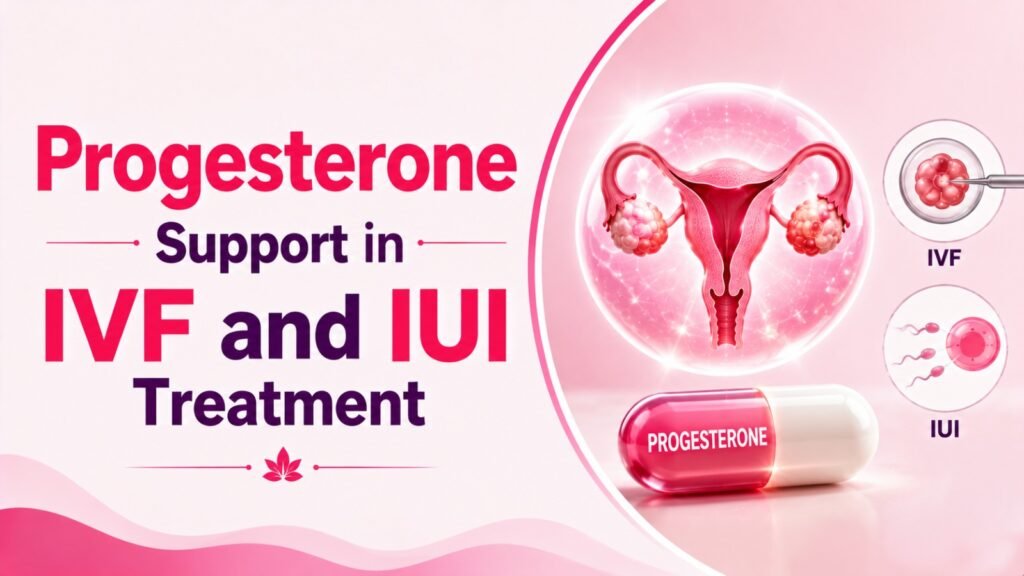
Treatment options such as In Vitro Fertilization (IVF) and Intrauterine Insemination (IUI) have made it possible for millions of couples to become parents. The likelihood of success with these treatments is often contingent on a variety of factors, such as hormone levels, uterine health, and embryo quality. One of the critical hormones in this process is referred to as progesterone.
In the case of IVF and IUI treatments, progesterone supports the preparation of the uterus for embryo implantation, as well as the early stages of pregnancy and embryo implantation, which may be affected in even the best circumstances.
In this guide, you will learn the Progesterone Support in IVF and IUI Treatment reasons for the prescribing of progesterone in the course of a fertility treatment, the mechanisms of progesterone, the forms of progesterone (including the side effects) and the ways for the successful use of progesterone.
What Is Progesterone?
Progesterone is a hormone which is naturally produced in the ovaries, and which is produced post ovulation. The production of progesterone happens in the placenta in the course of the pregnancy.
The Functions of Progesterone Include:
– Preparation of the endometrium for implantation of the embryo.
– Nutrition of the embryo in the early phases of pregnancy.
– Prevention of contractions of the uterus.
– Health of the pregnancy while the placenta is not yet functional.
Assisted reproductive techniques may lack the natural production of progesterone, thus making it necessary to use it in other ways.
Why is Progesterone Support in IVF and IUI Treatment Necessary?
During many of the fertility treatments, medications which stimulate the ovaries may interfere with the production of natural hormones during the course of the treatment.
In IVF, eggs are removed before the ovaries reach optimal hormonally supportive levels of progesterone. In these cases, it is necessary to provide hormonal support.
Progesterone support may increase successful pregnancies during certain IUI procedures involving ovulation-inducing drugs.
Specific objectives of Progesterone Support in IVF and IUI Treatment are:
– Higher implantation rates
– Higher successful pregnancy rates
– Stabilized uterine lining
– Less likelihood of early pregnancy loss
– Enhanced early embryo development
Supplementation of Progesterone has a positive impact in IVF procedures, as evidenced by a multitude of studies, and it is a mainstay recommendation of many fertility specialists.
Why Is Progesterone Important in IVF?
IVF is a multi-step process that involves stimulation of the ovaries, egg retrieval, fertilization, and the culture and transfer of embryos.
After the retrieval of eggs, the production of progesterone by the ovaries decreases as a result of:
– The removal of hormone-producing ovarian follicles
– The action of the fertility drugs
– The blocking of natural hormones
When there are not adequate levels of progesterone, the uterine lining becomes less receptive to the implantation of an embryo.
Supplementation of progesterone:
Supports the Luteal Phase
The luteal phase is the time between ovulation and the start of the next menstrual cycle, or the establishment of early pregnancy. The luteal phase is frequently deficient in IVF patients and thus, progesterone supplementation is crucial.
Increases Receptivity of Endometrium
Progesterone helps in the modification of the uterine lining to be suitable for embryo implantation.
Sustains Early Pregnancy
Progesterone supplements not only support the early embryo during the first trimester (10-12 weeks) when the placenta takes over the hormone support of pregnancy.
Do All IUI Cycles Need Progesterone Support?
Not all IUI Cycles need progesterone support.
Doctors might recommend progesterone due to the following factors:
– Use of ovulation induction drugs
– Suspected hormonal imbalance
– Previous implantation failures
– Luteal phase deficiency
– Recurrent pregnancy loss
For IUI cycles where ovulation occurs spontaneously, progesterone may not be required. Your doctor will evaluate your need for supplementation based on your history and the specific treatment you’re undergoing.
Progesterone Types in Fertility Treatment
Each of the available types of progesterone for fertility treatment has benefits associated with its use.
1. Vaginal Progesterone
This is the most prescribed progesterone for IVF cycles. It is available in:
– capsules
– tablets
– gels
Since vaginal progesterone is delivered directly to the uterus, has high efficacy, and results in fewer systemic side effects, it is ideal.
2. Progesterone Injections
Progesterone injections are also very effective.
Benefits include:
– Absorption is guaranteed
– Hormonal levels are steady
Disadvantages of treatment include pain, bruising, and soreness of the injected muscle.
3. Oral Progesterone
Oral progesterone is the most convenient, but may result in inadequate support of the uterus for IVF. Therefore, it is confined to treatment of select patients.
4. Sub cutaneous Progesterone
Some fertility programs are using progesterone injections that are subcutaneous.
Benefits include:
– delivery of hormones is effective
– convenient and less painful than the traditional methods of progesterone injections
When Does Progesterone Support Begin?
Support is initiated when the protocol requires it.
For IVF
– Usually begins after egg retrieval
– Usually begins after or on the day of embryo transfer
– Usually continues after a positive pregnancy
For IUI
– Usually begins after ovulation
– May continue for two weeks until the pregnancy test
If a pregnancy does occur, the doctor may recommend continuing progesterone until 10-12 weeks of pregnancy.
Progesterone is most often prescribed during IVF or IUI treatments.
Progesterone Side Effects
Progesterone is usually well-tolerated, but mild side effects may occur.
They may include:
– Breast tenderness
– Bloating
– Fatigue
– Mood changes
– Mild dizziness
– Vaginal discharge (for vaginal progesterone)
– Injection site soreness (for injectable progesterone)
Many of the side effects of progesterone may make you feel like you are pregnant, and may confuse you regarding the intended effects of the medication, versus the effects of pregnancy.
If side effects become severe, contact your fertility specialist.
Progesterone Injection Tips
Here are some tips to help you adhere to the treatment and support the strongest possible outcome for the pregnancy.
– Take the medication exactly as prescribed
– Don’t skip doses
– Set reminders or alarms
– Store the medication as prescribed
– Don’t stop taking the medication without advice
– Contact the doctor for unexpected symptoms
– Go to all the follow-ups
Enduring the treatment to maintain a steady concentration of progesterone aids in the support of a successful implantation and early pregnancy.
Does Progesterone Support Guarantee a Pregnancy?
No, and while progesterone support is a critical piece in the treatment of IVF and IUI, it does not guarantee a pregnancy.
Successful conception depends on the following:
– Quality of the embryo
– Quality of the egg
– Quality of the sperm
– The mother’s age
– The health of the uterus
– The health of the reproductive system
– The infertility diagnosis
While progesterone makes positive conception more likely by making the hormonal environment more favourable, there are still many other biological factors that come into play.
Other Factors that Support Fertility Treatment
In addition to progesterone supplementation, there are many lifestyle adjustments that can support the fertility journey, such as:
– Balanced and healthy diet
– Staying hydrated
– Getting enough sleep
– Not smoking or consuming alcohol excessively
– Reducing caffeine intake
– Managing stress through relaxation exercises
– Partaking in light physical exercise as approved by the physician
– Adhering to all instructions given by the fertility clinic
These lifestyle adjustments also improve fertility during the process.
Conclusion
Without a doubt, Progesterone Support in IVF and IUI Treatment has helped many women improve pregnancy outcomes as part of Assisted Reproductive Technology (ART). Progesterone prepares the uterine lining, aids in implantation, and helps support the early stages of pregnancy.
While success is not a guarantee, progesterone is the critical early pregnancy support to allow for early embryo implantation and development. Whether progesterone is as a vaginal capsule, injection, in a gel, or other formulations plays an important role if instructions by the specialist are adhered to.
Every fertility journey is different. If you are undergoing IVF or IUI, be sure to talk to your healthcare provider about your support regimen, be sure to ask questions, and adhere to any and all instructions. Combined with a healthy lifestyle, the right support will help you take the important steps to a successful pregnancy.
Frequently Asked Questions (FAQ)
It is standard recommendation from fertility specialists that progesterone is continued until around 10 to 12 weeks of pregnancy after conception occurs. The length of time is also dependent on the individual’s treatment.
Vaginal supplementation of progesterone is painless, however, there may be discomfort or soreness after intramuscular injections.
It is not recommended to stop progesterone under any circumstances unless instructed to by a fertility specialist, as there may be an immediate effect on the hormonal support during the early stages of pregnancy if it is stopped.
It does. Research has proven that there is an increase in both implantation and clinical pregnancy rates in IVF cycles with luteal phase support of progesterone.