
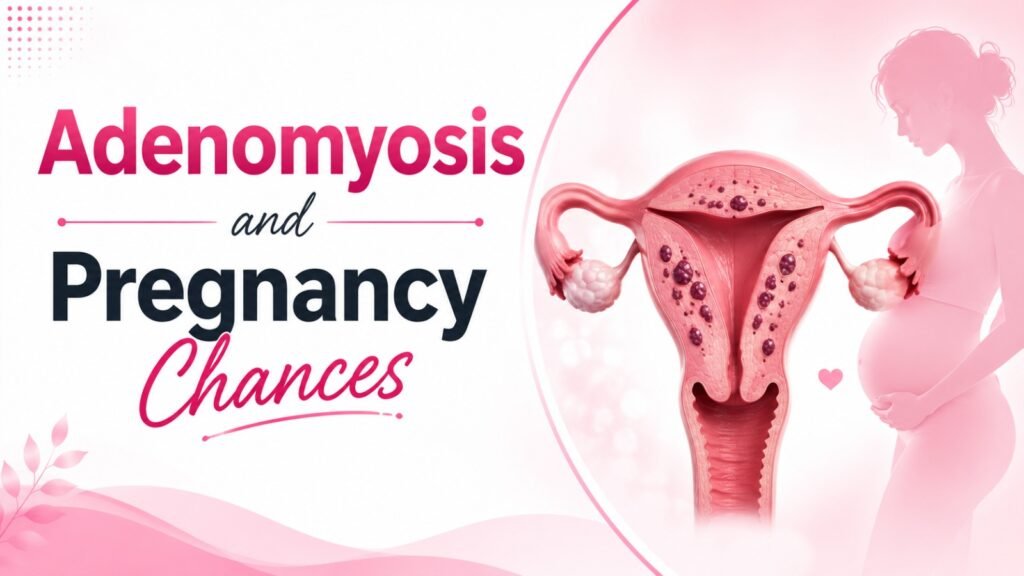
If you have been diagnosed with adenomyosis, you may be wondering whether you can still become pregnant and what the condition means for your fertility. The reassuring news is that adenomyosis does not automatically mean infertility. Many women with adenomyosis conceive naturally, while others may need fertility treatment.
Your adenomyosis and pregnancy chances depend on several factors, including your age, the extent of the condition, ovarian reserve, ovulation, fallopian-tube health, sperm quality, and whether you also have conditions such as endometriosis.
Understanding how adenomyosis may affect fertility is important because the condition can influence both conception and pregnancy outcomes. Research suggests that adenomyosis may be associated with lower pregnancy and live-birth rates and a higher risk of miscarriage and certain pregnancy complications. However, individual outcomes can vary significantly.
What Is Adenomyosis?
Adenomyosis is a condition in which tissue similar to the uterine lining grows into the muscular wall of the uterus. It can cause heavy or prolonged menstrual bleeding, painful periods, pelvic pain, pain during sex, and an enlarged or tender uterus. Some women, however, have few or no noticeable symptoms.
Because adenomyosis affects the uterine muscle and the junction between the uterine lining and muscle, researchers have examined whether these changes can interfere with implantation and reproductive function. Adenomyosis is also frequently found alongside endometriosis, which can independently affect fertility.
How Can Adenomyosis Affect Fertility?
There is no single fertility rate that applies to every woman with adenomyosis. Instead, adenomyosis and pregnancy chances are influenced by a combination of uterine, reproductive, and general fertility factors.
Researchers have proposed several possible mechanisms, including changes in uterine contractions, inflammation, blood flow, and endometrial receptivity. These changes may make implantation more difficult in some patients. Conditions such as endometriosis and fibroids may further affect fertility when they occur alongside adenomyosis.
Evidence from assisted reproductive treatment provides important insight. A systematic review and meta-analysis found that women with adenomyosis undergoing assisted reproductive technology had lower clinical pregnancy rates and higher miscarriage rates than comparison groups.
A 2024 meta-analysis also reported lower clinical pregnancy and live-birth rates and a higher miscarriage risk among women with adenomyosis undergoing IVF or ICSI.
Adenomyosis and Pregnancy Chances: Can You Conceive Naturally?
Yes. Natural conception is possible with adenomyosis, and a diagnosis should not be considered a guarantee of infertility.
For someone with regular ovulation, healthy fallopian tubes, adequate ovarian reserve, and no major additional fertility problems, trying to conceive naturally may be reasonable. However, adenomyosis and pregnancy chances may be less favourable when the condition is more extensive, symptoms are severe, age-related fertility decline is present, or other reproductive conditions occur at the same time.
There is no reliable way to predict an individual’s natural pregnancy chance based on an ultrasound diagnosis alone. A fertility specialist may evaluate:
- Age and reproductive history
- Ovulation and menstrual patterns
- Ovarian reserve
- Fallopian-tube health
- Semen quality
- Previous miscarriages or infertility
- Location and extent of adenomyosis
- Coexisting endometriosis or fibroids
Earlier fertility evaluation may be appropriate when adenomyosis is significant, symptoms are severe, pregnancy is a priority, or there is a history of infertility or recurrent pregnancy loss.
Adenomyosis and Pregnancy Chances With IVF
IVF can overcome some causes of infertility, but it cannot completely eliminate the potential effects of adenomyosis on the uterine environment. Research has raised concerns about implantation, clinical pregnancy, live birth, and miscarriage outcomes among women with adenomyosis undergoing IVF.
A 2021 systematic review reported an odds ratio of 0.69 for clinical pregnancy and 2.17 for miscarriage following assisted reproductive treatment in women with adenomyosis compared with women without the condition.
A 2024 meta-analysis reported a 26% lower clinical pregnancy rate, 35% lower live-birth rate, and higher miscarriage rate among women with adenomyosis undergoing IVF/ICSI compared with women without adenomyosis.
These findings describe population-level trends rather than an individual’s personal chances of success. Adenomyosis and pregnancy chances can still be favourable enough for IVF to be a reasonable treatment option, particularly when other fertility factors support treatment.
Fertility specialists may tailor the IVF approach to the individual and may sometimes consider hormonal suppression before embryo transfer. However, evidence regarding the optimal pre-treatment strategy is still evolving, and no single protocol is appropriate for every patient.
Adenomyosis and Pregnancy Chances: Does It Increase Miscarriage Risk?
Research suggests that adenomyosis is associated with a higher risk of miscarriage, particularly among women undergoing assisted reproduction. A systematic review found increased odds of miscarriage in women with adenomyosis following ART.
This does not mean that miscarriage is inevitable. Many women with adenomyosis go on to have successful pregnancies. Rather, adenomyosis may be one of several factors that clinicians consider when planning preconception care and pregnancy monitoring.
Pregnancies affected by adenomyosis have also been associated with higher rates of complications such as preterm birth, hypertensive disorders, placental abnormalities, small-for-gestational-age or low-birth-weight babies, and postpartum haemorrhage.
The strength of evidence is not the same for every outcome, and individual risk may differ substantially from the averages reported in research studies.
Does Adenomyosis Need Treatment Before Pregnancy?
Not necessarily. Treatment decisions depend on symptoms, the pattern and extent of disease, age, fertility goals, and previous treatment history.
Hormonal medications can help control pain and heavy menstrual bleeding, but many hormonal treatments prevent pregnancy while they are being used. For that reason, treatment decisions should take your plans for pregnancy into account.
For selected patients, fertility-sparing procedures such as adenomyomectomy or other uterus-preserving treatments may be considered. A systematic review found that pregnancy can occur after conservative treatment, but the available evidence largely comes from selected patient groups and does not establish that surgery is appropriate for everyone.
Surgery involving the uterine muscle can also cause scarring and may increase the risk of uterine rupture in a subsequent pregnancy. This makes individualized planning with an experienced gynecologic surgeon and fertility specialist particularly important.
Adenomyosis and Pregnancy Chances by Age
Age remains one of the most important predictors of fertility. Even when adenomyosis is present, age-related changes in egg number and quality can have a major impact on the likelihood of conception.
For this reason, adenomyosis and pregnancy chances should never be assessed from the uterine diagnosis alone. Someone in their late 30s or 40s who wants to become pregnant may benefit from an earlier fertility assessment rather than waiting for several months without evaluation.
Depending on individual circumstances, a fertility specialist may discuss ovarian-reserve testing, IVF, or fertility-preservation options such as egg or embryo freezing.
What Tests Can Help Assess Fertility?
A fertility evaluation usually looks beyond adenomyosis itself. Depending on your medical and reproductive history, testing may include a detailed medical and menstrual history, ovulation assessment, transvaginal ultrasound, and, in some cases, MRI for additional assessment of the uterus.
Standard fertility testing may also evaluate:
- Ovarian reserve
- Fallopian tubes
- Semen parameters
- Ovulation
- Other reproductive conditions
The goal is to identify all of the factors that may affect conception rather than assuming that adenomyosis is the only cause of reduced fertility.
Lifestyle and Preconception Health
There is no specific diet, supplement, or home remedy proven to cure adenomyosis or guarantee pregnancy. However, healthy preconception habits can still support overall reproductive health.
Maintaining a healthy weight, avoiding smoking, limiting alcohol, exercising regularly, managing chronic health conditions, getting adequate sleep, and taking folic acid as recommended are all important aspects of preconception care.
Be cautious about supplements marketed as “natural fertility cures.” Many have limited supporting evidence, and some may interact with medications or fertility treatments.
What Happens After a Positive Pregnancy Test?
A positive pregnancy test is an important milestone, and having adenomyosis does not mean that complications are certain. Let your obstetrician or fertility team know about your diagnosis, as well as any previous uterine surgery or fertility treatment.
Your doctor may review your medical history, ultrasound findings, symptoms, and other risk factors to determine whether additional monitoring is appropriate. Recent large reviews continue to report associations between adenomyosis and several adverse maternal and neonatal outcomes, supporting individualized obstetric care.
During pregnancy, seek urgent medical attention for heavy bleeding, severe abdominal or one-sided pelvic pain, fainting, significant dizziness, or other concerning symptoms.
Final Takeaway
Adenomyosis can make fertility more complicated, but it does not close the door to pregnancy. Some women conceive naturally, while others may benefit from IVF or a personalized fertility strategy.
The most useful approach is to evaluate adenomyosis alongside age, ovarian reserve, ovulation, fallopian-tube health, sperm factors, endometriosis, and the specific characteristics of the uterine disease.
In other words, adenomyosis and pregnancy chances are not an all-or-nothing equation. With timely evaluation, appropriate treatment when needed, and individualized reproductive care, many women with adenomyosis can continue working toward a healthy pregnancy.