
There are millions of infertile couples across the globe. For many infertile couples, fertility treatment provides hope for conception. One of the frequently asked questions by infertile patients is:
“How does IVF work?”
If you are thinking of receiving fertility treatment from a trusted fertility clinic, or are simply looking for the best IVF centres near you, knowing how IVF works can help alleviate unease and make decisions for you.
In this guide, the reader can find information related to the possible steps in the process of in vitro fertilization, its success rates, as well as the possible risks, all explained in simple language, though of great medical use.
What Is IVF? (IVF Full Form Explained)
The full form of IVF is In Vitro Fertilization.
- In vitro means outside the body”
- Fertilization” is the act of combining egg and sperm.
In IVF, fertilization does not take place within the fallopian tube but in the laboratory. The fertilized cell then develops and implants in the uterus to form pregnancy. fertility treatment is one of the most advanced and successful treatments for infertility, particularly when the other treatments such as IUI have not worked.
Why Is IVF Done?
A fertility specialist may recommend fertility treatment in cases such as:
- Blocked or damaged fallopian tubes
- Severe male infertility (low sperm count or motility)
- PCOS (Polycystic Ovary Syndrome)
- Endometriosis
- Unexplained infertility
- Age-related infertility
- Genetic disorder prevention (via embryo testing)
- Repeated IUI failure
Leading fertility centres evaluate hormone levels, ovarian reserve, semen analysis, and uterine health before recommending in vitro fertilization.
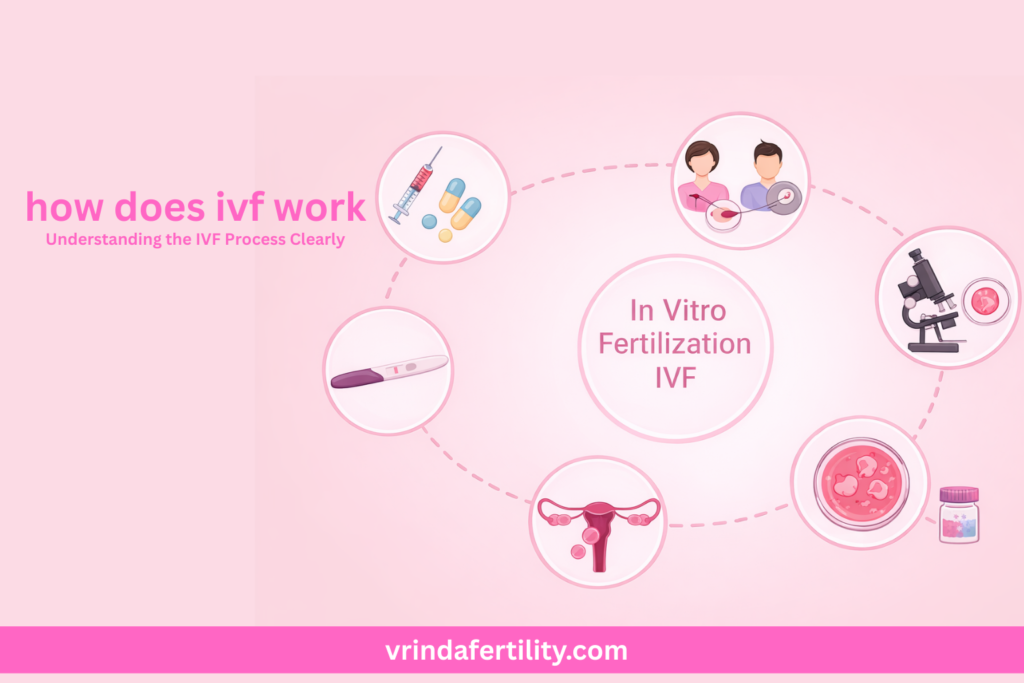
How Does treatment Work? Step-by-Step IVF Process
Understanding how fertility treatment works becomes easier when broken into clear stages.
1. Ovarian Stimulation (Egg Production Phase)
Under normal circumstances, a female can release just one egg per month. However, with IVF treatments, fertility drugs are used to release multiple mature eggs.
This phase consists of:
- Hormonal Injections (FSH & LH)
- Regular Ultrasound Monitoring
- Blood Test for Hormone Levels
In this, multiple follicles are stimulated to develop in order to increase the probability of successful fertilization.
Duration: 8–14 days
2. Egg Retrieval (Oocyte Pickup)
After the eggs have matured, a minor surgical intervention called egg retrieval is carried out.
- Done under mild anesthesia
- Takes 15–20 minutes
- Uses ultrasound guidance
- Eggs are collected using a thin needle
Patients usually go home the same day.
3. Sperm Collection & Fertilization
A semen sample is collected from the male partner (or donor sperm is used if needed).
Fertilization can occur in two ways:
Conventional IVF
Egg and sperm are placed together in a lab dish.
ICSI (Intracytoplasmic Sperm Injection)
A single healthy sperm is injected directly into the egg.
ICSI is often recommended in cases of male infertility.
4. Embryo Development (3–5 Days)
After fertilization:
- The embryo is monitored in a specialized incubator
- It grows for 3–5 days
- Best-quality embryos are selected
Some fertility centres offer blastocyst transfer (Day 5 transfer) for improved implantation rates.
5. Embryo Transfer (Final Step)
The selected embryo is placed into the uterus using a thin catheter.
- Painless procedure
- No anesthesia required
- Takes about 10 minutes
After transfer, patients enter the “two-week wait” before a pregnancy test confirms success.
How Long Does Laboratory Fertilization Process Take?
Typically, one fertility treatment cycle takes:
- 4 to 6 weeks from start to pregnancy test
- Frozen embryo transfer cycles may take slightly less time
Your fertility specialist may personalize the protocol based on age, hormone levels, and medical history.
IVF Success Rates: What to Expect?
fertility treatment success rates depend on:
- Age (higher under 35)
- Egg quality
- Sperm quality
- Uterine health
- Experience of the fertility center
Average success rates per cycle:
- Under 35 years: 40–60%
- 35–40 years: 30–40%
- Over 40 years: 10–20%
Choosing the best IVF centre with advanced lab technology significantly improves outcomes.
Risks and Side Effects of In Vitro Fertilization Treatment
While treatment is generally safe, some risks include:
- Mild bloating or cramping
- Ovarian Hyperstimulation Syndrome (OHSS)
- Multiple pregnancy (if multiple embryos transferred)
- Emotional stress
A reputable fertility centre follows strict safety protocols to minimize risks.
Advanced Techniques in Modern In Vitro Fertilization
Top fertility centres now offer:
- Preimplantation Genetic Testing (PGT)
- Frozen embryo transfer (FET)
- Laser-assisted hatching
- Time-lapse embryo monitoring
- Donor egg
These advancements enhance implantation rates and reduce genetic risks.
Who Is the Ideal Candidate for In Vitro Fertilization ?
fertility treatment is ideal for:
- Couples trying for 1+ year without success
- Women over 35 with declining ovarian reserve
- Blocked fallopian tubes
- Severe male factor infertility
- Recurrent pregnancy loss
An experienced fertility specialist will assess whether treatment is the best infertility treatment option for you.
Emotional and Financial Considerations
treatment is both an emotional and financial investment. Before starting treatment:
- Discuss realistic expectations
- Understand cost breakdown
- Ask about payment plans
- Seek counseling if needed
A supportive fertility centre will guide you throughout the journey.
Frequently Asked Questions
1. How painful is In Vitro Fertilization treatment?
Most steps involve mild discomfort. Egg retrieval is done under anesthesia, and embryo transfer is painless.
2. How many In Vitro Fertilization cycles are usually needed?
Some couples conceive in the first cycle, while others may need 2–3 cycles.
3. Is In Vitro Fertilization pregnancy different from natural pregnancy?
No. Once implantation occurs, pregnancy progresses normally.
4. What is the success rate of In Vitro Fertilization on the first try?
Success varies by age and health factors but averages 40–50% for women under 35.
5. Can IVF guarantee pregnancy?
No fertility treatment guarantees pregnancy, but treatment offers the highest success rates among assisted reproductive technologies.
Conclusion:
As a matter of fact, fertility treatment facilitates the fertilization process outside the human body. Also, healthy embryos are transferred into the uterus to enable pregnancy. The process of fertility treatment includes ovarian stimulation, egg retrieval, fertilization, embryo culture, and transfer.
Nevertheless, treatment is a complex procedure, and it is actually a lot simpler when one understands every stage of the process. With a highly qualified and advanced fertility center, your odds of success improve naturally.IF YOU ARE CONSIDERING FERTILITY TREATMENT, it is a good idea to consult a professional and qualified fertility expert to see if IVF treatment is appropriate for you.
When performed at a trusted fertility center, offers a safe, effective, and scientifically proven path toward parenthood.At Vrinda Fertility, we personally guide every couple – bringing medical expertise, latest technology, and emotional support to realize your dream of becoming parents. Get Direction for Best IVF Centre In Delhi and Noida