
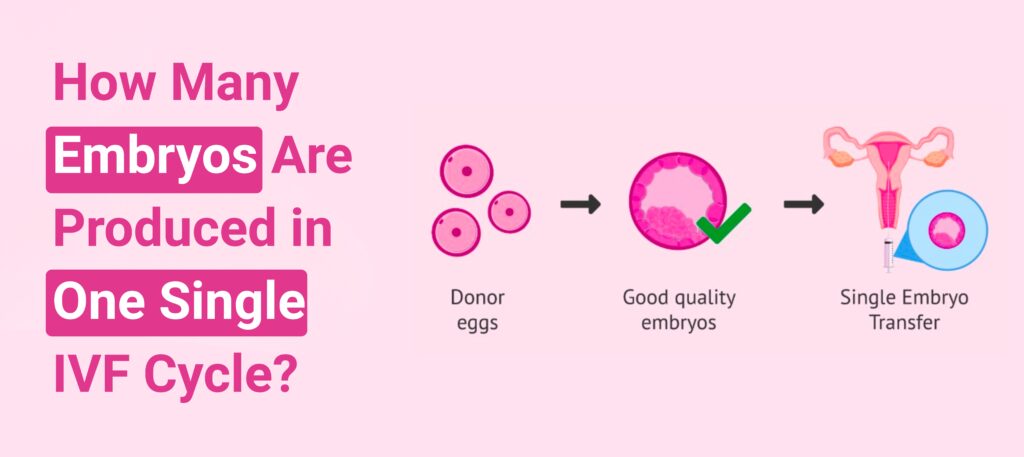
When couples begin their IVF journey, a common question arises — “How many embryos are produced in one IVF cycle?”
The answer depends on many biological and clinical factors, like age, egg reserve, sperm quality, and hormonal response.
At Vrinda Fertility, with advanced fertility centres, we help couples understand and improve embryo production for better pregnancy outcomes.
Understanding the IVF Process: From Egg to Embryo
In In-Vitro Fertilisation (IVF), eggs are collected from the woman’s ovaries and fertilised with sperm in a specialised laboratory. Once fertilisation occurs, embryos start developing — typically over 3 to 5 days. The IVF process includes:- Ovarian Stimulation – Hormonal injections encourage multiple eggs to mature.
- Egg Retrieval – Eggs are gently collected under ultrasound guidance.
- Fertilisation – Eggs are combined with sperm (naturally or via ICSI).
- Embryo Culture – Fertilised eggs grow into embryos under monitored lab conditions.
- Embryo Transfer – The best-quality embryos are transferred into the uterus.
Average Number of Embryos Produced per IVF Cycle
On average:- 10 to 15 eggs are retrieved from the ovaries.
- About 70–80% fertilise successfully.
- Around 5 to 10 embryos are typically formed.
- Total eggs retrieved: 10–15
- Fertilised eggs: 7–10
- High-quality embryos: 3–5
- Transfer-ready (blastocyst) embryos: 1–3
Key Factors That Affect Embryo Count
1. Age of the Woman
- Women under 35 usually produce more viable eggs and embryos.
- After 35, egg quality and embryo viability may decline.
2. Ovarian Reserve
- AMH levels and Antral Follicle Count (AFC) are strong predictors of how many eggs a woman can produce.
3. Sperm Quality
- Low motility or abnormal morphology can reduce fertilisation efficiency.
4. Stimulation Protocol
- Our specialists design personalised IVF protocols to optimize your body’s response to medication.
5. Laboratory Conditions
- Temperature, air quality, and embryo culture media directly affect embryo survival.
- Vrinda Fertility Labs in both Delhi and Noida follow international IVF lab standards.
6. Lifestyle & Health
- Diet, sleep, stress, smoking, and alcohol consumption influence egg and sperm health.
How Many Embryos Are Transferred in IVF?
While several embryos may be formed, only the best-quality ones are transferred to the uterus to reduce risks. Typical embryo transfer guidelines:- Under 35 years: 1 embryo
- 35–40 years: 1–2 embryos
- Above 40 years: Up to 3 embryos (if quality is poor)
Does More Embryos Mean Higher IVF Success?
Not necessarily. IVF success depends more on embryo quality, not quantity. Even one high-grade blastocyst can lead to a successful pregnancy. At Vrinda Fertility, we enhance success by:- Culturing embryos to the Day-5 blastocyst stage
- Using ICSI (Intracytoplasmic Sperm Injection) for male infertility
- Offering PGT-A (Genetic Testing) to identify chromosomally normal embryos
Realistic Expectations: IVF Is Different for Everyone
Each woman’s body reacts uniquely to IVF stimulation. Some produce five embryos; others 15. What truly matters is the health and genetic normalcy of the embryos. Our team at Vrinda Fertility, Noida & Delhi, provides personalised care to optimize your chances of conception — with compassion, transparency, and medical precision.Why Couples Trust Vrinda Fertility in Noida & Delhi
Vrinda Fertility is among the most trusted IVF & fertility centres in Delhi NCR, known for delivering ethical and practical reproductive care. We offer:- Advanced IVF & ICSI treatment
- Expert fertility specialists & embryologists
- High-quality laboratory standards
- Affordable IVF cost in Noida & Delhi
- EMI & zero-cost financing options
- Personalised fertility plans
Conclusion
The number of embryos produced in one IVF cycle varies for each couple — but with expert care, even a single healthy embryo can lead to a successful pregnancy. At Vrinda Fertility, with centres in both Noida and Delhi, we blend advanced reproductive technology with a compassionate approach to give you the best chance of building your family. Your journey to parenthood starts here — book your consultation today with Vrinda Fertility, Delhi NCR’s trusted IVF centre.Frequently Asked Questions (FAQ)
Q1: How many embryos are usually produced per IVF cycle?
A: On average, 5–10 embryos are produced, depending on age, ovarian reserve, and sperm quality.
Q2: How many embryos are transferred during IVF?
A: Usually, 1–2 embryos are transferred to minimize multiple pregnancies.
Q3: Can I increase the number of embryos produced?
A: Yes, through optimized stimulation, diet, supplements, and advanced lab methods like ICSI.
Q4: What happens to unused embryos?
A: They are frozen for future IVF cycles, donated, or used for research (with your consent).
Q5: Do more embryos mean higher IVF success?
A: Not necessarily — embryo quality and uterine receptivity are more important than sheer numbers.