
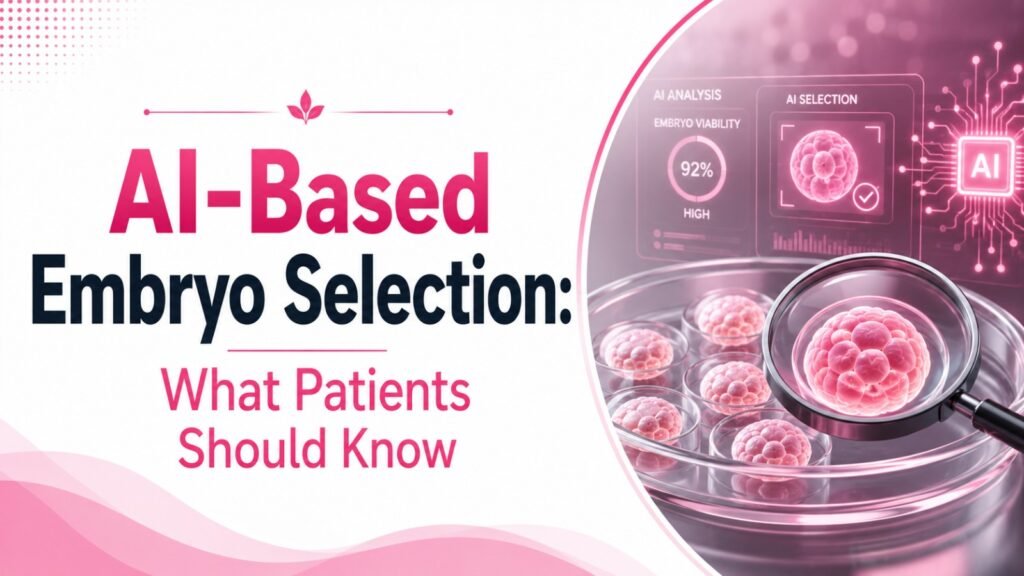
Advances in reproductive medicine are transforming the way fertility treatments are delivered, and one of the most exciting developments is AI-based embryo selection. By combining artificial intelligence with advanced imaging technology, fertility specialists can evaluate embryos with greater precision and consistency during in vitro fertilization (IVF).
Traditionally, embryologists have assessed embryo quality by observing their appearance under a microscope and monitoring their development. While this method remains highly valuable, it relies on expert interpretation, which can naturally vary between specialists. AI adds another layer of analysis by processing thousands of embryo images and comparing developmental patterns with historical IVF outcomes. The result is data-driven support that helps identify embryos with the highest likelihood of successful implantation.
It’s important to remember that AI does not replace fertility experts. Instead, it serves as a decision-support tool that complements the experience and clinical judgement of embryologists. For individuals and couples investing emotionally, physically, and financially in IVF, understanding how this technology works can help them make informed decisions about their fertility treatment.
What Is AI-Based Embryo Selection?
AI-based embryo selection is the use of artificial intelligence and machine learning to evaluate embryo quality during IVF. Specialised software analyses digital images captured throughout embryo development and predicts which embryo is most likely to implant successfully.
Unlike conventional grading methods that primarily focus on visual assessment, AI evaluates multiple developmental parameters simultaneously. These include embryo morphology, cell division timing, blastocyst formation, developmental consistency, and historical implantation data gathered from thousands of previous IVF cycles.
The technology identifies subtle patterns that may not always be visible to the human eye. However, AI recommendations are never used in isolation. Embryologists carefully review the results alongside the patient’s medical history, age, fertility diagnosis, and other clinical factors before making the final decision.
How AI-Based Embryo Selection Works
During an IVF cycle, mature eggs are fertilized in a laboratory, where the resulting embryos are cultured for several days. Many modern fertility clinics use time-lapse incubators that capture high-resolution images of each embryo every few minutes without disturbing its environment.
The AI system examines numerous characteristics throughout embryo development, including:
- Cell division timing
- Cell symmetry
- Blastocyst expansion
- Fragmentation levels
- Developmental milestones
- Overall morphology
The software compares these observations with extensive databases of previous IVF outcomes to generate an implantation probability score or rank embryos according to their predicted potential.
Rather than making treatment decisions independently, AI provides objective information that embryologists use alongside their clinical expertise. This collaborative approach helps improve consistency and confidence in embryo selection.
Benefits of AI-Based Embryo Selection
More Consistent Embryo Evaluation
One of the greatest advantages of AI-based embryo selection is its consistency. Since AI evaluates embryos using standardized algorithms, it reduces variations that may occur with manual assessment alone.
Improved Clinical Decision-Making
Choosing which embryo to transfer is one of the most important steps in IVF. AI provides fertility specialists with additional evidence to support informed and objective decisions.
Higher Implantation Potential
Research suggests that AI-assisted embryo assessment may improve the accuracy of embryo selection. By identifying embryos with stronger implantation potential, the technology may contribute to better IVF outcomes for suitable patients.
Although no technology can guarantee pregnancy, selecting the most viable embryo increases the chances of success.
Supports Single Embryo Transfer
Many fertility specialists now recommend transferring one healthy embryo whenever appropriate to reduce the risk of multiple pregnancies.
AI helps identify the embryo with the highest implantation potential, making single embryo transfer a safer and more effective option.
Increased Laboratory Efficiency
Artificial intelligence can analyze thousands of embryo images within minutes, allowing embryologists to work more efficiently while maintaining high standards of accuracy and consistency.
Does AI Replace Embryologists?
No.
A common misconception is that artificial intelligence makes treatment decisions independently. In reality, AI-based embryo selection is designed to assist experienced fertility professionals rather than replace them.
Embryologists continue to:
- Evaluate embryo quality
- Review patient medical history
- Consider maternal age
- Assess infertility diagnosis
- Recommend embryo transfer timing
- Make final clinical decisions
Human expertise remains essential throughout every stage of IVF treatment.
Who Can Benefit from AI-Based Embryo Selection?
Although every fertility journey is unique, AI-assisted embryo evaluation may be particularly beneficial for:
- Patients undergoing IVF for the first time
- Couples with several embryos available
- Women of advanced maternal age
- Patients with previous unsuccessful IVF cycles
- Individuals choosing elective single embryo transfer
- Couples seeking additional confidence in embryo selection
A fertility specialist can determine whether this technology is suitable based on individual medical circumstances.
Limitations of AI-Based Embryo Selection
Despite its advantages, patients should understand that AI has limitations.
It Cannot Guarantee Pregnancy
Even embryos ranked highly by AI may not implant successfully. Pregnancy depends on many additional factors, including uterine receptivity, hormonal balance, embryo genetics, maternal health, and lifestyle factors.
Results Depend on Data Quality
The performance of AI algorithms depends on the quality and diversity of the data used for training. Laboratory protocols, imaging systems, and patient populations may influence prediction accuracy.
Availability Differs Between Clinics
Not all fertility centres currently offer AI-assisted embryo evaluation. Patients should ask whether their clinic uses validated AI technology and how it contributes to treatment planning.
Additional Costs
Some clinics include AI as part of their IVF package, while others charge separately. Discuss pricing and expected benefits before beginning treatment.
AI-Based Embryo Selection vs. Genetic Testing
Although they are often confused, AI-based embryo selection and Preimplantation Genetic Testing (PGT) serve different purposes.
AI evaluates embryo development using digital image analysis without touching the embryo. PGT, on the other hand, examines embryo chromosomes through a biopsy to identify certain genetic abnormalities.
Many fertility specialists use both technologies together when medically appropriate, as they provide complementary information.
Is AI-Based Embryo Selection Safe?
Yes.
AI-based embryo selection is considered a non-invasive technology because it analyzes images collected during routine embryo culture without physically interacting with the embryo.
The safety of the process depends primarily on maintaining high laboratory standards rather than the AI software itself.
Questions to Ask Your Fertility Clinic
Before choosing an IVF program that uses AI, consider asking:
- Which AI platform does your clinic use?
- Has it been clinically validated?
- How does AI support embryo selection?
- Is AI included in the treatment package?
- Will embryologists still review my embryos?
- Is AI recommended for my specific fertility condition?
Asking these questions can help you better understand how AI fits into your personalized treatment plan.
Ethical Considerations
The growing use of artificial intelligence in reproductive medicine raises important ethical questions. Topics such as patient privacy, data security, algorithm transparency, informed consent, and equal access to advanced fertility technologies continue to be discussed within the medical community.
Reputable fertility clinics explain how AI contributes to embryo evaluation while ensuring patients remain fully informed throughout the decision-making process.
The Future of AI in IVF
Artificial intelligence continues to evolve rapidly, and researchers are exploring new ways to improve IVF outcomes. Future developments may include more personalized embryo assessments, enhanced implantation predictions, better integration with genetic testing, increased laboratory automation, and more precise fertility treatment planning.
As additional clinical evidence becomes available, AI-based embryo selection is expected to become an increasingly valuable tool in modern reproductive medicine.
Conclusion
AI-based embryo selection represents an important advancement in fertility care by combining artificial intelligence with expert clinical judgement. Rather than replacing embryologists, it enhances embryo evaluation through data-driven insights that support more consistent and informed decisions during IVF.
While AI offers promising benefits, successful pregnancy still depends on multiple factors, including embryo quality, maternal health, uterine receptivity, and high-quality clinical care. Patients considering AI-assisted IVF should discuss the technology with their fertility specialist, understand its benefits and limitations, and choose a clinic that follows evidence-based practices.
As research continues to advance, AI-based embryo selection is expected to play an increasingly significant role in improving IVF outcomes and helping more individuals and couples achieve their dream of building a family.
Frequently Asked Questions (FAQ)
It is a technology that uses artificial intelligence to analyze embryo development during IVF and identify embryos with the highest likelihood of successful implantation.
AI may improve embryo selection accuracy and support clinical decision-making, but it cannot guarantee pregnancy.
Yes. The technology is non-invasive because it analyzes digital images without physically affecting the embryo.
No. AI supports embryologists by providing additional objective analysis, while experienced specialists make all final treatment decisions.
No. Detecting genetic abnormalities requires Preimplantation Genetic Testing (PGT), whereas AI evaluates embryo development and quality.