
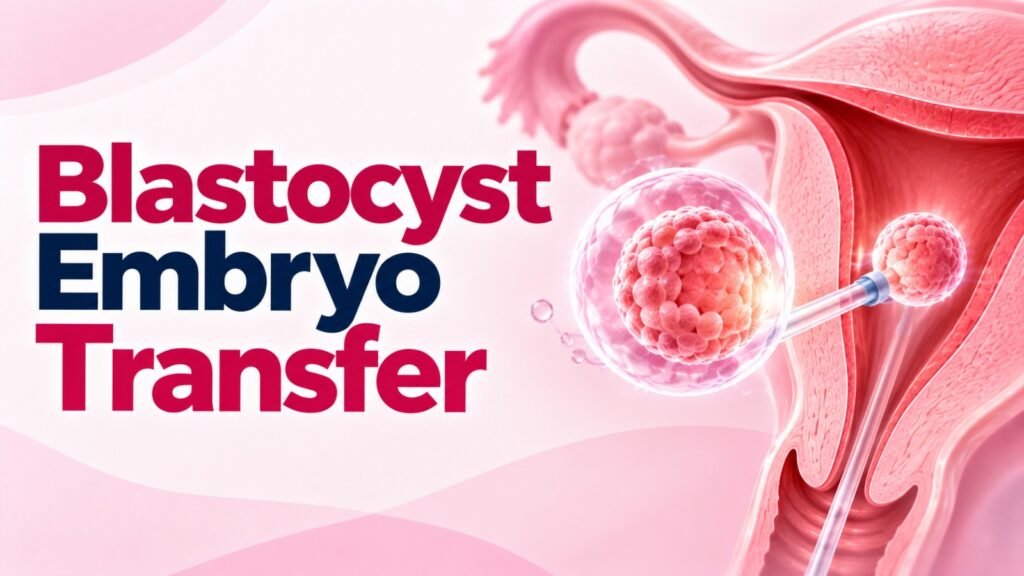
When undergoing IVF, one of the most important decisions is when to transfer the embryo. Traditionally, embryos were often transferred on Day 3, when they contain around 6–10 cells. Today, many IVF clinics culture embryos for several additional days and transfer them at the blastocyst stage, usually on Day 5 or sometimes Day 6.
So, which approach gives better results?
In many patients, blastocyst transfer can provide higher implantation and ongoing pregnancy rates per embryo transferred, largely because embryos that successfully reach the blastocyst stage have demonstrated the ability to continue developing in the laboratory. It can also make embryo selection easier and may reduce the number of embryos needed for transfer.
However, this does not mean Day 3 embryo transfer is outdated or unsuitable for everyone. Patients with a small number of embryos, certain previous IVF outcomes, or particular clinical circumstances may be advised to consider an earlier transfer.
The right choice should therefore be individualized rather than based solely on statistics.
Blastocyst vs Day 3 Embryo Transfer at a Glance
| Feature | Day 3 Embryo Transfer | Blastocyst Transfer |
|---|---|---|
| Transfer timing | Around Day 3 after fertilization | Usually Day 5–6 |
| Developmental stage | Cleavage-stage embryo | Blastocyst |
| Typical cell structure | Approximately 6–10 cells | Around 100+ cells with differentiated cell groups |
| Laboratory culture | Shorter | Longer |
| Embryo selection | More limited | Generally greater opportunity for selection |
| Implantation potential per embryo | Can be good | Often higher in appropriately selected patients |
| Risk of having no embryo available for transfer | Lower | Higher when very few embryos are available |
| Number of embryos often transferred | Depends on individual circumstances | Often suitable for single-embryo transfer |
| Best approach | Patient-specific | Patient-specific |
What Is a Day 3 Embryo Transfer?
A Day 3 embryo transfer involves placing an embryo into the uterus approximately three days after fertilization.
At this point, the embryo is generally at the cleavage stage and commonly contains several cells. The embryo has undergone multiple divisions but has not yet developed into a blastocyst.
Historically, Day 3 transfer was widely used because IVF laboratories did not always have the technology or culture conditions needed to maintain embryos until Day 5.
Today, improvements in embryo culture and laboratory techniques have made extended culture to the blastocyst stage much more common.
How does Day 3 transfer work?
The general IVF process is:
- Ovarian stimulation encourages multiple follicles to develop.
- Eggs are collected during egg retrieval.
- Eggs are fertilized using conventional IVF or ICSI.
- Fertilized eggs develop in the laboratory.
- An embryo may be selected for transfer around Day 3.
- The embryo is placed into the uterus using a thin catheter.
- Remaining suitable embryos may be cultured further or cryopreserved, depending on the treatment plan.
One potential advantage is that embryos do not need to survive an additional two days in the laboratory before transfer.
What Is a Blastocyst Transfer?
A blastocyst transfer involves transferring an embryo after approximately five or six days of development.
Instead of remaining at the early cleavage stage, the embryo has developed a more complex structure consisting primarily of:
- Inner cell mass (ICM): cells that develop into the fetus.
- Trophectoderm: cells that contribute primarily to the placenta.
- Blastocoel: the fluid-filled cavity inside the blastocyst.
Reaching the blastocyst stage represents an important developmental milestone.
Not every embryo created during IVF will reach this stage. This is one reason blastocyst culture can provide useful information for embryo selection—but it is also one of its limitations.
Blastocyst vs Day 3 Embryo Transfer: Which Has Higher Success Rates?
This is one of the most common questions asked by IVF patients.
The answer depends on what outcome is being measured and which patients are being compared.
When appropriately selected patients have embryos that successfully reach the blastocyst stage, blastocyst transfer can have a higher implantation rate per embryo transferred than cleavage-stage transfer.
There are several reasons for this.
First, extended embryo culture allows embryologists to observe which embryos continue developing successfully. Second, the embryo is transferred at a developmental stage that more closely corresponds to the embryo’s natural arrival in the uterus.
However, comparing success rates can be misleading if researchers simply compare:
“Pregnancy rate after Day 3 transfer”
versus
“Pregnancy rate after blastocyst transfer.”
Patients selected for blastocyst transfer may differ significantly from patients undergoing Day 3 transfer. Age, ovarian reserve, embryo number, embryo quality, infertility diagnosis and previous treatment history can all affect results.
The key distinction: per-transfer vs cumulative outcome
A blastocyst strategy may produce a stronger result per transfer, but that does not automatically mean it will produce a better cumulative live-birth rate for every patient.
For example, a patient may begin with only two embryos. If neither develops into a blastocyst, there may be no embryo available for a Day 5 transfer.
With Day 3 transfer, an embryo could potentially be transferred before that additional developmental hurdle occurs.
Therefore, the most meaningful comparison is often the cumulative chance of live birth from all embryos created in a treatment cycle, rather than simply the success rate of one transfer.
Why Can Blastocyst Transfer Have Better Implantation Rates?
Several biological and clinical factors may explain the advantage.
1. Natural selection in the laboratory
Embryos develop at different rates.
Some embryos stop developing before Day 5. Others continue developing and form good-quality blastocysts.
Culturing embryos for several days therefore provides another opportunity to identify embryos that have demonstrated continued developmental potential.
Importantly, reaching the blastocyst stage does not guarantee genetic normality or pregnancy.
2. Better synchronization with the uterus
In natural conception, fertilization occurs in the fallopian tube. The developing embryo travels toward the uterus and generally reaches the blastocyst stage around the time it enters the uterine cavity.
Blastocyst transfer attempts to reproduce this developmental timing more closely than a Day 3 transfer.
3. More opportunities for embryo assessment
At the blastocyst stage, embryologists can assess features such as:
- Expansion of the blastocyst
- Inner cell mass appearance
- Trophectoderm appearance
- Overall developmental progression
These characteristics can help embryologists rank embryos for transfer or freezing.
However, morphology is not a perfect measure of embryo genetics.
Does Blastocyst Transfer Increase the Chance of Pregnancy?
It can, particularly when comparing appropriately selected patients and a single blastocyst with a suitable-quality cleavage-stage embryo.
But patients should be cautious about interpreting clinic success rates without understanding how they are calculated.
A clinic may report:
- Pregnancy rate per embryo transfer
- Clinical pregnancy rate
- Implantation rate
- Ongoing pregnancy rate
- Miscarriage rate
- Live birth rate
- Cumulative live birth rate
These are not interchangeable.
Live birth is the most important outcome
For someone undergoing IVF, the ultimate goal is not simply implantation or a positive pregnancy test. It is a healthy live birth.
Therefore, when comparing Day 3 and blastocyst transfer, ask the fertility specialist:
“What is the live-birth rate for patients like me, and is that calculated per transfer or cumulatively per IVF cycle?”
This question provides much more useful information than asking which method has the highest pregnancy percentage in general.
Advantages of Blastocyst Transfer
Better embryo selection
The additional culture period gives embryologists more information about embryo development.
Potentially higher implantation efficiency
A suitable blastocyst can have a strong implantation potential, particularly when transferred singly.
Supports single embryo transfer
Because blastocysts can provide good implantation potential, they are often compatible with a single-embryo transfer strategy.
This can reduce the risk associated with transferring multiple embryos.
Useful for preimplantation genetic testing
When preimplantation genetic testing is part of an IVF treatment plan, embryos are generally biopsied at the blastocyst stage rather than at the early cleavage stage.
Limitations of Blastocyst Transfer
Blastocyst culture is not automatically better for every patient.
Some embryos stop developing
The most important limitation is that some embryos that appear suitable on Day 3 will not reach the blastocyst stage.
For patients who produce only one or two embryos, this may be an important consideration.
Longer laboratory culture
Embryos must remain in culture for additional days, making laboratory conditions and embryology expertise particularly important.
A good-looking blastocyst is not necessarily genetically normal
Embryo morphology cannot reliably determine whether an embryo has the correct number of chromosomes.
Even a high-quality blastocyst can fail to implant or result in miscarriage.
Advantages of Day 3 Embryo Transfer
Day 3 transfer may still have a role in modern IVF treatment.
Transfer occurs earlier
The embryo does not have to remain in the laboratory until Day 5 or Day 6.
Potentially useful when embryo numbers are very low
For patients with a very small number of embryos, the fertility specialist may consider whether extended culture introduces a meaningful risk of having no embryo available for transfer.
May be appropriate in selected clinical circumstances
Individual treatment history matters. A previous IVF cycle, embryo development pattern, laboratory performance and patient preferences can all influence the decision.
Limitations of Day 3 Transfer
The main disadvantage is that embryo selection is based on an earlier developmental stage.
At Day 3, embryos have had less time to demonstrate whether they can continue developing toward the blastocyst stage.
This means the embryology team has less developmental information available when choosing an embryo.
Additionally, Day 3 morphology alone cannot determine whether an embryo is chromosomally normal.
Is Blastocyst Transfer Better for Older Women?
Maternal age is one of the strongest factors influencing IVF outcomes because the proportion of chromosomally abnormal embryos tends to increase with age.
Blastocyst culture may provide an additional selection step, but it does not eliminate the effect of age.
For an older patient who produces several embryos, extended culture may help identify embryos that continue developing well.
On the other hand, if only one or two embryos are available, the possibility that none reaches the blastocyst stage needs to be considered.
Therefore, age should be evaluated alongside:
- Number of eggs retrieved
- Fertilization rate
- Number of normally fertilized embryos
- Previous embryo development
- Embryo quality
- Ovarian reserve
- Previous IVF outcomes
- Whether genetic testing is planned
What If I Have Only One or Two Embryos?
This is where the decision becomes particularly individualized.
Suppose a patient has only one embryo after fertilization. The fertility team has to balance two possibilities:
Day 3 transfer:
Transfer the embryo earlier before it has to demonstrate continued development in the laboratory.
Blastocyst culture:
Allow the embryo to develop further, potentially gaining more information about its developmental potential—but accepting the possibility that it may arrest before transfer.
There is no universally correct answer.
The clinic’s embryology results and the patient’s previous history can be especially valuable in making this decision.
Does Blastocyst Transfer Reduce Miscarriage?
Not necessarily in every situation.
Miscarriage is strongly influenced by factors including embryo chromosomal status and maternal age.
Blastocyst development may allow better embryo selection based on developmental characteristics, but morphology alone cannot reliably identify chromosomally normal embryos.
When a euploid embryo has been identified through appropriate preimplantation genetic testing, the situation is different from simply selecting a blastocyst based on appearance.
Patients should therefore avoid assuming:
Better-looking blastocyst = guaranteed healthy pregnancy.
IVF outcomes are influenced by multiple biological factors.
Blastocyst Transfer and Frozen Embryo Transfer
Modern IVF increasingly uses frozen embryo transfer (FET).
Instead of transferring a fresh embryo immediately, embryos can be cryopreserved and transferred during a later cycle.
Blastocyst-stage embryos are routinely frozen using modern vitrification techniques.
This approach can allow the clinical team to:
- Prepare the uterine lining separately
- Schedule transfer at an appropriate time
- Perform embryo testing when indicated
- Preserve suitable embryos for future attempts
- Consider single embryo transfer
Whether fresh or frozen transfer is preferable depends on the patient’s medical circumstances and the clinic’s protocol.
What About PGT-A With Blastocyst Transfer?
Preimplantation genetic testing for aneuploidy (PGT-A) is performed on cells taken from a developing blastocyst.
The goal is to identify embryos with chromosome numbers consistent with euploidy.
PGT-A can provide additional information about embryo chromosome status, but it is important to understand that:
- It does not guarantee implantation.
- It does not guarantee a live birth.
- It does not test for every possible genetic or developmental condition.
- Its usefulness can vary according to patient characteristics.
The decision to use PGT-A should therefore be individualized rather than assumed to be necessary for every IVF cycle.
Which Embryo Transfer Is Better for You?
There is no single answer that applies to every IVF patient.
A blastocyst transfer may be particularly attractive when:
- Several good-quality embryos are available.
- The laboratory has strong blastocyst culture performance.
- Embryo selection is important.
- Single embryo transfer is being considered.
- PGT-A or another blastocyst-stage testing strategy is planned.
Day 3 transfer may be considered when:
- Very few embryos are available.
- Previous cycles showed poor blastocyst development.
- The treating fertility specialist believes early transfer is appropriate.
- Individual clinical circumstances make extended culture less desirable.
The decision should be based on your individual embryo cohort, not just the headline success rate of one transfer method.
Final Verdict: Blastocyst vs Day 3 Embryo Transfer
If we look only at implantation potential and embryo selection, blastocyst transfer often has an advantage because the embryo has demonstrated continued development through Day 5 or Day 6.
But the question “Which gives better results?” is more complicated than simply choosing Day 5.
For patients with multiple good-quality embryos, blastocyst culture can provide valuable selection opportunities and can support single embryo transfer. For patients with very few embryos, however, the possibility of embryo arrest before Day 5 can make the decision more nuanced.
Ultimately, the best transfer strategy depends on age, embryo number and quality, previous IVF outcomes, laboratory performance, genetic testing plans and the individual clinical situation.
The most useful conversation with your fertility specialist is therefore not simply “Day 3 or Day 5?” but:
“Given my embryos and my treatment history, which strategy gives me the best realistic chance of a live birth?”
That is the question most likely to lead to a personalized and evidence-based IVF decision.
Visit Vrinda Fertility
Take the next step toward your parenthood journey with expert fertility care, advanced treatments, and personalized treatment plans.
Visit Vrinda Fertility today and consult experienced fertility specialists to understand your fertility needs and explore the right treatment options for you.