
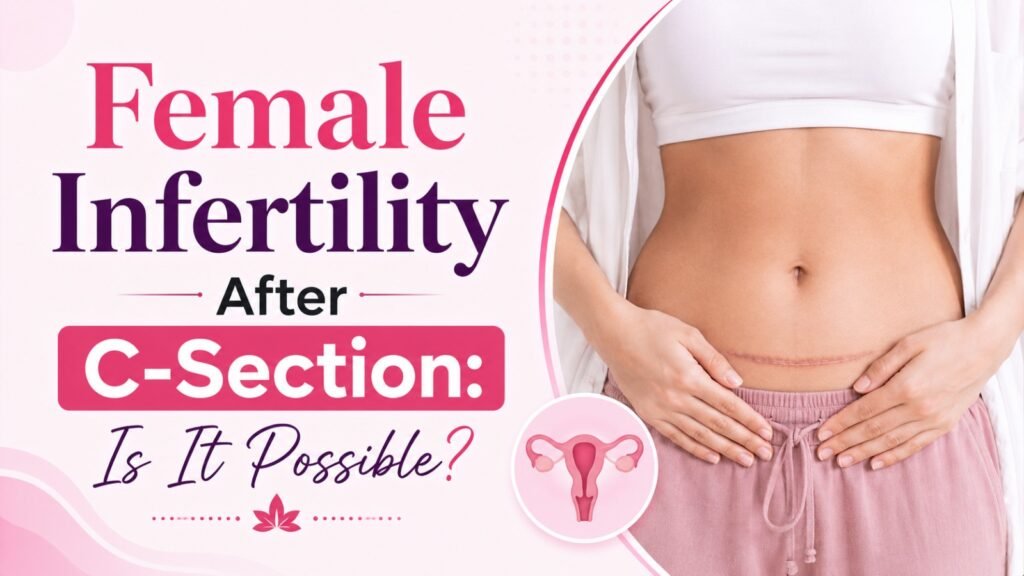
A cesarean section is a safe and common way for women to bring babies into the world through surgery. This procedure has assisted millions of women in delivering healthy babies. Nevertheless, many women that want to expand their families through more natural means after a C-section wonder about the effect that C-Sections may have on their fertility.
The question in their minds whether a C-section may cause infertility is more common than ever with more cesarean births happening. Even though most women may conceive naturally after a C-section, the effect of the surgery and its challenges may cause a delay.
This article helps in understanding the relationship between female infertility after C-Section by addressing the different causes, challenges, and diagnosis and treatment solutions. It also outlines the different functional approaches to improve reproductive health
Female Infertility After C-Section: Is It Possible?
The simple answer is yes, but only in a few rare cases.
Directly, C-Sections may not be a cause to infertility. Most women who have had one, two, or three cesarean sections go on to have healthy pregnancies. However, some of the challenges of the surgery may indirectly affect the ability to conceive.
Some of the challenges of the C-Section may be the formation of scar tissue, and healing of the uterus or formation of adhesions. These challenges may also cause infertility or may make conceiving and even pregnancy challenging. Fortunately, some of these challenges may be resolved with medical intervention.
How Does a C-Section Affect the Reproductive System?
Let us first understand how the reproductive system may be affected by a C-Section.
During a cesarean section, one may have to cut through the walls of the abdomen, as well as the walls of the uterus, in order to retrieve the baby.
The C-Section may also impact how the uterus heals, as well as how the body may fight infections, especially ones that may be in the reproductive system.
Like any type of injury, trauma to the uterus from surgery will heal by forming a scar in the tissue.
Although normal healing usually results in no complications, insufficient healing or the formation of excessive scar tissue may impact the function of some of the adjacent reproductive organs, including:
- The uterus
- The fallopian tubes
- The ovaries
- The tissues in the pelvis
Such formations may contribute to infertility in a small number of women.
Reasons for Female Infertility Post C-Section
1. Cesarean Scar Defect (C-Section Scar Niche)
A C-Section scar defect, isthmocele, or niche is one of the most common post-surgical complications that may cause infertility.
Here, the C-Section healing leaves a small pocket in the wall of the uterus.
Such a defect may:
– trap menstrual fluid
– cause chronic inflammation
– impede the implantation of an embryo
– decrease the likelihood of achieving pregnancy
Women who have significant defects may experience symptomatic, abnormal, short-interval menstruation.
2. Adhesions
Following any intra-abdominal surgery, scar tissue may develop within the pelvis.
Adhesions may:
– bind reproductive organs
– block the fallopian tubes
– impede the movement of ovaries
– cause pain in the pelvis
Adhesions do not develop in all women. However, even in a small number of cases, significant adhesions may reduce natural fertility.
3. Infection Post-Surgery
Post-surgical infection may rarely occur following a C-Section.
Failure to treat a developing infection may cause damage to:
– the uterus
– the fallopian tubes
– the endometrium
Pelvic inflammatory disease (PID), post-surgical infection, may increase the risk factors for infertility.
4. Changes in Endometrium
The lining of the uterus (endometrium) must be healthy for implantation of embryos to occur.
Post-surgery endometrial scarring or chronic inflammation can make embryo implantation tricky.
5. Secondary Infertility
This is the condition when women become concerned after having one child immediately, then having difficulty conceiving again.
In some cases, the previous C-section may play a part. More often, age, hormonal changes, ovulation issues, thyroid issues, weight changes, and male factors may be involved.
Who Is at Greater Risk?
Fertility complications after a C-Section may also affect some women. These women may face risks from:
– Multiple cesareans
– Post-surgery infections
– Difficulty with wound healing
– Endometriosis
– Previous surgeries on the pelvis
– Severe adhesions within the pelvis
– Uterine anomalies
– Advanced maternal age
Even within this population of women, infertility is not a given.
Symptoms That May Indicate a Problem
You should see a gynaecologist if:
– You have attempted natural conception for 12 months or more with no success
– You have unexplained pelvic pain
– You have pain during intercourse
– Your menstrual flow is heavy
– You have spotting after your menses
– Your menses are irregular
– You have multiple recurrent pregnancy losses
– You have dysmenorrhea
These may indicate a defect with a scar and/or a reproductive condition that requires diagnosis and treatment.
How Doctors Diagnose Fertility Problems After a C-Section
An invasive fertility work-up normally consists of:
Medical History
The physician notes:
– The number of your C-sections
– Your pregnancy history
– The history of your menses
– Your history of infections
– Your fertility history
Pelvic Ultrasound
Transvaginal ultrasound can help identify:
– C-Section Scar Issues
– Abnormal Uterus
– Ovarian Disorders
– Fibroids
Saline Infusion Sonography (SIS)
This method of imaging combines sterile saline to produce better quality images of the uterine cavity and the scarring.
Hysteroscopy
Implants a camera in the uterus to assess:
– Scar Defects
– Polyps
– Adhesions
– Abnormal Uterus
Hysterosalpingography (HSG)
A unique prospective x-ray that determines patency of the fallopian tubes and assesses structural uterine scarring.
Blood Tests
A panel of hormone tests that assess:
– Ovulation
– Thyroid
– Ovarian Reserve
– Fertility Hormones
Treatment Options
Treatment is based on the issue.
Surgical Repair of Scar Defects
Large C-Section Scar Niches are amenable to repair via minimally invasive surgery.
– Hysteroscopic Repair
– Laparoscopic Surgery
– Hybrid Procedures
Improved fertility has been reported by many women post procedure.
Removal of Adhesions
If adhesion of the abdomen is preventing conception, laparoscopic surgery may be performed to remove the adhesions and restore normal anatomy.
Fertility Medications
Adjuvant therapies that may be useful in the treatment of women with anovulation include medications that stimulate ovulation.
Assisted Reproductive Technologies (ART)
If the problem is insurmountable to natural conception, the fertility specialist may employ:
– IUI
– IVF
Due to the structural fertility issues of many of the couples, IVF may improve fertility and successful pregnancy, especially when coupled with infertility.
Can You Have a Healthy Pregnancy After a C-Section?
Yes.
Most women who had a C-section can still carry a baby to full term.
Doctors usually say to wait 18-24 months after a C-section to get pregnant again to allow the uterine wall time to heal completely, cutting down complications for the mother and baby.
C-sected women need to attend preconception counselling to ensure that the reproductive system can safely support another pregnancy.
Improving Fertility After a C-Section
Although the following suggestions may help with reproductive health, no lifestyle changes help guarantee that you will not have fertility issues.
– Stay within a healthy weight range.
– Follow a healthy diet with loads of fruits and vegetables, protein, and healthy fat.
– Stay active.
– Eliminate (or limit) smoking and alcohol.
– Reduce stress.
– Go to your doctor regularly.
– Follow the pregnancy spacing your doctor recommends.
Taking these steps helps ensure that you carry the next pregnancy to full term.
When to See a Fertility Specialist
You need to go to your doctor if:
– you are under 35 and have not gotten pregnant after a year of trying,
– you are over 35 and have not gotten pregnant in the last 6 years,
– you have had multiple miscarriages,
– you have severe pelvic pain,
– you have abnormal bleeding, or
– you have concerns about complications from your prior C-section.
Generally, the sooner you are diagnosed, the sooner you will be treated and the better the outcome of the pregnancy will be.
Conclusion
Having a previous C-Section does not lead to infertility. In fact, the majority of women go on to have healthy pregnancies after having a C-Section. Issues such as infections or scar pelvic adhesions can affect your fertility, and if they occur, they should be evaluated right away.
Do not lose hope if you are having trouble getting pregnant after a C-Section. There are many tools that assist with fertility and can diagnose the issue you may be facing. This, combined with modern treatments, can offer you a healthy pregnancy. You should reach out to a qualified gynaecologist and fertility specialist as soon as you can to enhance the probability of having a healthy pregnancy and to expand your family.
Frequently Asked Questions (FAQ)
An uncomplicated C-section has little to no correlation with infertility. When they do occur, complications of surgery tend not to impact long-term reproductive health. Most women will have no problems conceiving naturally after surgery.
Scar tissue will make conceiving more difficult if it has become so extensive that it is obstructing the fallopian tubes. Adhesions (bands of scar tissue that connect to internal organs) can form in the pelvis and may affect the implantation of the embryo.
Most women will conceive naturally after resolving the underlying issue, so IVF is not typically warranted. There is generally a greater need for IVF when other fertility factors are involved and other treatments have had little to no success.
No, not in all cases. There are many cases of spontaneous natural conception after addressing the cause. As IVF is not the first line of treatment, It is often used when associated with other infertility issues.