
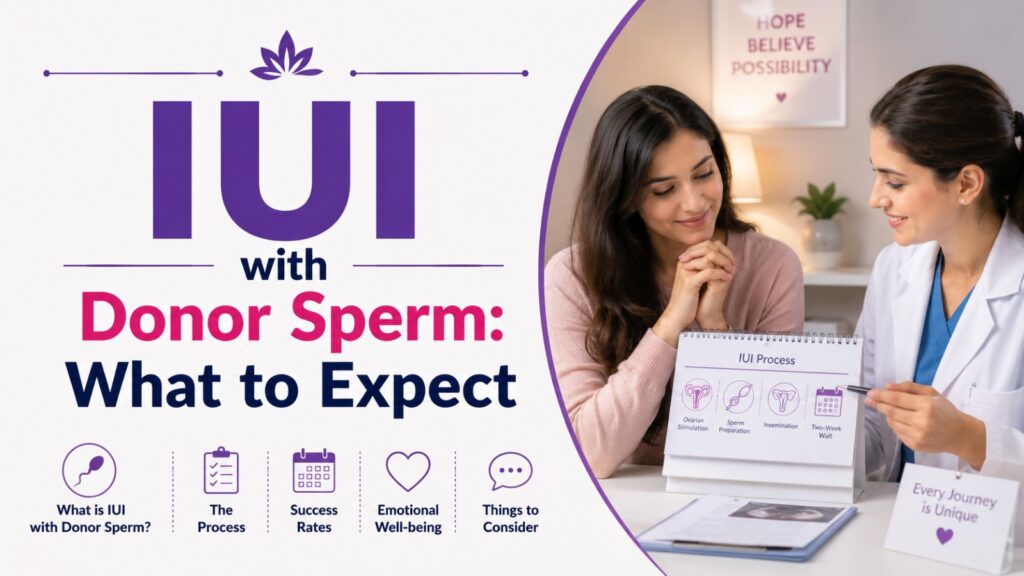
Balancing hope with plenty of logistics and emotions while answering a myriad of questions can be really overwhelming. The fact that you are looking into IUI with donor sperm shows that you are going through this and are likely a single parent by choice, in a same-sex relationship, or have male-factor infertility or are dealing with related concerns. Intrauterine insemination (IUI) with donor sperm is a common treatment option and a really low intervention option.
It is a much easier and less demanding procedure compared to IVF. However, it is totally understandable that you want to know what to expect with donor sperm IUI so that you can prepare yourself for the procedure.
What is IUI with Donor Sperm?
IUI (intrauterine insemination) is a procedure that is done to place sperm that has been prepared in a laboratory directly into the uterus after it has been timed to coincide with ovulation.
If you are using donor sperm, you are selecting sperm from a screened donor and not a partner.
This procedure is done to place the sperm in the uterus closest to the egg in order to make fertilization the most likely to occur.
Why people choose donor sperm IUI
IUI using donor sperm can be a good option for:
– – Single women or singles by choice
– – Female partners in same-sex couples
– – Couples with a significant level of male-factor infertility
– – Individuals wanting to avoid passing on a genetic condition to their child
– – Individuals requiring donor conception for their fertility needs
IUI is less expensive than IVF and is less invasive. Because of this, IUI is chosen more often than IVF when donor sperm is utilized.
Step 1: Selecting a Donor or Donor Sperm Bank
Selecting donor sperm from a licensed sperm bank or fertility clinic is one of the first steps when trying to conceive incorporating donor sperm. This step can be surprisingly emotional when trying to balance personal preferences with practical considerations.
What To Search For In Donor Sperm Programs
Sperm banks and fertility clinics usually offer screening for a variety of factors. These may include:
– infectious disease
– genetic conditions
– family medical history
– semen quality and quantity
– health and lifestyle factors
Other information may be available. These can include:
– height, education, and ethnicity
– audio or video interviews, written interviews, or childhood photos
– personality notes, interests, or hobbies
– options for Open-ID or identity-release.
Step 2: Your Fertility Workup Before IUI
Sperm banks and fertility clinics usually offer screening for a variety of factors. These may include:
Common Tests Before Donor Sperm IUI
The following may be required:
– Blood samples to check your hormones and your ovarian reserve.
– A screening physical for an infectious disease.
– A pelvic ultrasound.
– Ovulation or cycle monitoring.
– An HSG or other test to check the patency of your fallopian tubes.
Why is this important? Because IUI is effective when your fallopian tubes are at least partially open and you are able to ovulate. It allows the sperm and ovum to meet post insemination.
If your fallopian tubes are blocked and if significant endometriosis and other fertility issues are suspected, your doctor may present a different plan focusing on IVF instead of repeated IUI cycles.
Step 3: Timing the IUI Cycle
The most important aspect of IUI is the timing. The insemination must happen around the same time that you are ovulating.
There are two ways you can do IUI with a donor.
1) Natural Cycle IUI
In natural cycles, ovulation is not assisted. Instead, the clinic closely monitors your cycle through:
– An ovulation predictor kit (LH test)
– Blood work
– Ultrasound monitoring.
Your provider may suggest this option when you have normal cycles with no issues with ovulation.
2) Medicated IUI
Some patients are prescribed medications to boost ovulation. This makes it more likely to release multiple eggs. Your doctor may prescribe:
– Oral ovulation medications
– Injectable fertility drugs
– Trigger shot for more precise ovulation timing
Using medication can increase the likelihood of pregnancy as IUI is more effective in these cases. However, the likelihood of multiples is also higher.
Step 4: What Happens to the Donor Sperm Before IUI?
For those using frozen donor sperm, which is the most common, the sperm is thawed and prepared by the clinic, or andrology lab.
Sperm prep will most likely include a step called sperm washing. This helps to separate out motile sperm and remove other components of the sample. The sample is ready to be placed in the uterus by the time you arrive for the IUI.
This process is done by the clinic, so there is usually nothing else you need to do, other than confirming the donor sperm has arrived and the paperwork has been done.
Step 5: What the IUI Procedure Feels Like
What does donor sperm IUI feel like is the most popular question.
The actual procedure is usually very quick.
During the IUI procedure
Typically:
1. You will lie on an exam table, similar to how you would during a pelvic exam.
2. A speculum will be inserted into the vagina to visualize the cervix.
3. A thin catheter will be placed through the cervix and into the uterus.
4. The prepared donor sperm will be placed into the uterus through the catheter.
5. Both the catheter and speculum will be removed.
That’s all there is to it!
Step 6: What to Expect After IUI with Donor Sperm
After the IUI, the most challenging part often begins: the two-week wait.
Common symptoms after IUI
For the first few days after, you may have:
– Mild cramping
– Light spotting
– Tender breasts
– Bloating
– Fatigue
Because of the causes including ovulation, progesterone, fertility medications, and possibly early pregnancy, the symptoms will not indicate if the IUI was successful.
Success Rates: How Successful Is IUI with Donor Sperm?
Several factors affect IUI success rate.
– Age
– Egg quality and ovarian reserve
– Open fallopian tubes
– Regular ovulation
– Uterine health
– Fertility medication
Donor sperm can be a good sign for IUI cycles, because sperm banks are thorough and picky with strong quality samples. But, IUI is not a one cycle guarantee.
It is common to need ./m /m multiple IUI cycles.
When Doctors Recommend Moving On
If pregnancy still hasn’t happened after several cycles, your doctor may decide to change things up. These changes may include:
– New medications
– New timing
– New infertility tests
– IVF
There are no set rules on how many IUIs you should go through to get pregnant. Your doctor will base your next steps on your age, diagnosis, previous cycles, and your body’s response to treatment.
The Emotions Behind Donor Sperm IUI
There are many emotions IUI may bring up for you. You may feel any of the following:
– Grief
– Relief
– Excitement
– Uncertainty
– Hope
Many people have a hard time letting go of the future they expected. You may have to make a lot of decisions, including how to explain to your children your donor choice, who the donor is, if there are siblings, and the costs and time involved.
There are many good forms of support to help you process your treatment including:
– A therapist who specializes in this field
– Online support groups
– Support individuals during treatments
– Journaling your thoughts after each cycle.
Fertility treatments can be physically simple, but mentally taxing. You don’t have to go through this alone.
Donor Sperm IUI: What to Expect for Your First Cycle
Getting an IUI for the first time can be an exciting time, but nerve-wracking. There are a few things you can do to help alleviate some of the nerves.
Before the day of IUI
– Double check the sperm has arrived to the clinic.
– Find out how your medication schedule will sync up with your monitoring schedules.
– Talk to your doctor to see if you need to start taking prenatal vitamins.
– Call the clinic to find out at what time you should call to report a positive ovulation test.
– Complete the payment, storage, and consent paperwork in advance.
Day of IUI
– Dress Comfortably
– Be Sufficiently Informed on the Schedule
– Bring a pad as some light spotting might occur.
– Try to keep the rest of your day low stress.
After IUI
– Follow any medication instructions
– Try to avoid obsessing over any symptoms.
– Mark the day you will take your pregnancy test.
– Seek emotional support.
Final Thoughts on IUI with Donor Sperm
For many people the process of IUI with donor sperm can be an overwhelming experience, but once the process officially begins, most people find that the process is more structured and easier to handle than what they originally thought.
As a fertility treatment, donor sperm IUI is designed to provide the best opportunity for egg and sperm to meet. This process is drawn out and involves selecting a sperm donor, undergoing a battery of fertility tests, and timing everything correctly for the quick in office procedure. Then the hardest part, waiting for the results.
IUI with donor sperm is what it is – a fertility treatment that can’t guarantee success. Getting an idea of such limitations, along with other aspects of the method, is intended to eliminate any apprehension around the treatment and help you better prepare.
You should kick things off by visiting a licensed fertility clinic. They’ll assess your medical history and help you work through your options, such as whether IUI suits you.
Frequently Asked Questions (FAQ)
An IUI cycle coincides with your menstrual cycle. The process takes approximately 2 – 4 weeks.
Each option has its advantages and disadvantages. In general, IUI has a lower cost and is a less invasive procedure. In certain contexts, IVF has a higher chance of success, which can lead to IUI being more favorable. It really depends on the situation.
IUI can definitely work on the first attempt, however a lot of people require multiple attempts for success.
IUI isn’t a painful procedure, but there may be some slight cramps, and IUI is a relatively quick procedure.