
Male infertility is more common than expected and there are modern fertility solutions to assist couples trying to conceive. TESA treatment is one such option. If you were just introduced to the term TESA by your fertility doctor and are finding it hard to comprehend the medical terminology, this will help you with everything, explained in simple terms.
This article will cover the definition of TESA treatment, the reasons for performing the procedure, how the procedure is performed, the expected recovery, the risks and benefits, the success rates, and the FAQs.
What Is TESA Treatment?
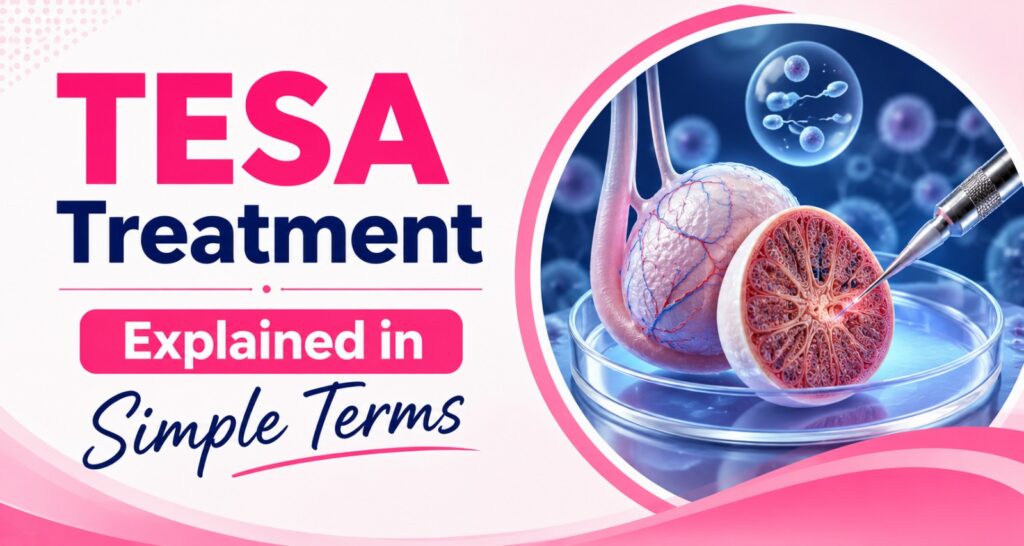
TESA is short for Testicular Sperm Aspiration. This procedure is performed to collect sperm directly from the testicles when sperm cannot be found in the semen.
TESA treatment is offered to men who have some cause of infertility. The sperm that is collected is then used for IVF (In Vitro Fertilization) and ICSI (Intracytoplasmic Sperm Injection) procedures.
Essentially, TESA is a solution that doctors use to collect sperm from the testicles when sperm cannot be provided from the process of ejaculation.
Why Is TESA Treatment Needed?
TESA treatment is generally suggested when a man has:
- A blockage that prevents the sperm from being deposited in the semen
- A very low sperm count
- No sperm in the semen (azoospermia)
- Previous vasectomy
- Ejaculation problems
- Genetic or hormonal conditions affecting fertility
There are two main types of azoospermia:
1. Obstructive Azoospermia
In this type of azoospermia, sperm is produced in the testes, but cannot be ejaculated due to obstruction.
2. Non-Obstructive Azoospermia
In this type, there is low or no sperm production in the testes.
Both types of azoospermia can be treated by testicular sperm aspiration (TESA) and the success of the procedure depends on the type of azoospermia.
Mechanism of TESA Treatment
In TESA, an aspiration is performed on the testes by a fertility physician (FP) to obtain sperm. It is a minor surgery performed as a day care procedure. It takes about 15-30 minutes to complete the procedure.
Steps in TESA
Consultation
Before the procedure, a physician may order certain investigations, including, but not limited to:
– Semen analysis
– Hormone tests
– Ultrasound
– Genetic studies
– Fertility evaluation
Administer Local/Mild Anaesthesia
The aspiration site is made numb to decrease pain of the procedure.
Needle Aspiration
A fine needle is inserted in the testes to obtain the tissue where sperm is present.
Examination of the Sample
The obtained tissue is then examined to find out the sperm within the lab setting.
Fertilization
The sperm obtained can be used for fertilization immediately or can be cryopreserved for future use.
Is TESA Painful?
Most of the patients report TESA aspiration to be of a minor pain only due to the local anaesthesia.
After the procedure, men may experience:
– Tenderness
– Swelling
– Minor bruising
– Minor pain
All of these symptoms typically resolve within a few days.
Who Is a Good Candidate for TESA Treatment?
TESA treatment may cater to:
1. Men with azoospermia
2. Men with blocked sperm ducts
3. Couples planning IVF or ICSI
4. Men who previously had a vasectomy
5. Men who are unable to ejaculate
6. Patients with previously failed sperm retrieval attempts through ejaculation
Ultimately, the final decision will be made by a fertility specialist after conducting the necessary tests to determine the candidate’s eligibility.
We hope this helps.
Benefits of TESA Treatment
TESA treatment offers several advantages for couples struggling with infertility.
Minimally Invasive Procedure
Large surgical cuts are avoided.
Quick Recovery
Most men are able to resume normal activities within days.
Short Procedure Time
The entire procedure is mostly done in 30 minutes.
Helps Achieve Biological Parenthood
Using TESA, it is possible for a couple to conceive using the male partner’s sperm.
Outpatient Procedure
The procedure does not generally require an overnight stay at a hospital.
Risks and Side Effects of TESA Treatment
Like any medical procedure, TESA treatment comes with some risk factors, and serious complications are rare.
Common Side Effects
1. Mild pain
2. Swelling
3. Bruising
4. Temporary tenderness
Rare Complications
1. Infection
2. Bleeding
3. Testicular tissue damage
4. Failure to retrieve sperm
The risks listed above can be minimised by following the after-care instructions recommended by the doctor.
Recovery After TESA Treatment
Getting back to normal after treatment takes a short time, and has minimal side effects.
Recovery Tips
1. Rest for 24 to 48 hours
2. Wear supportive underwear
3. Avoid heavy exercise for a few days
4. Ice the area. Only ice if recommended 5. Take medications as prescribed
Most patients make a full recovery in about a week.
– Adhere to fasting guidelines if provided
– Stay clear of smoking and drinking
– Work with the doctor to get a full medication list
– Do all the prescribed tests
– Plan a ride for after your treatment
Removing negative lifestyle factors may promote sperm development.
Lifestyle Changes That may Increase Male Fertility
Improving lifestyle habits are almost always a part of doctor’s suggestions for all types of fertility treatment.
Healthy Habits for Fertility
– Consume a balanced diet
– Regular exercise
– A healthy body weight
– Lower stress
– Do not smoke or drink excessively
– Sleep enough
– Do not let the temperature around genital area get too hot
Emotional Effects of Male Infertility
Being unable to father children has negative effects on mental health, self-esteem and also affects interpersonal relationships. Most couples feel anxious, stressed, frustrated and emotionally drained.
It is important for couples to work with fertility counsellors and doctors, and be part of a fertility support group to help them cope with all aspects of fertility treatment.
Frequent Questions To Ask a Fertility Specialist
Here are a few questions that may help every patient understand the process before they undergo TESA:
– Patents may want to consider asking what the cause of the infertility is.
– What would be the likelihood of sperm retrieval?
– Will the intent be to perform ICSI or to create an IVF cycle?
– Will there be other options other than IVF and ICSI? If there are what are they and why would they be a part of the recommendation?
– What are the various other risks of this?For how long does the expected stay after this procedure will be? How many days is a patient expected to stay during recovery? What is the expected outcome and success of this?
Having the ability to ask questions means the patients are able to give completely informed consent.
Conclusion
TESA is a safe and minor surgical procedure for men with azoospermia or oligospermia to father a child. By employing testicular sperm retrieval, it offers hope to couples with male infertility.
The procedure description in simplified language is meant to demystify the process and alleviate nerves. If you’re considering the TESA procedure, book an appointment with an experienced reproductive specialist to understand your medical condition, your chances of success, and the treatment options valuable to you.
The recent advances in IVF and ICSI reproductive technology have made it possible to create numerous families by offering the hope of a healthy pregnancy in couples struggling with infertility.
Frequently Asked Questions (FAQ)
TESA stands for Testicular Sperm Aspiration.
Yes, TESA treatment is safe, especially when carried out by a professional fertility expert.
This treatment normally takes between 15 and 30 minutes.
Yes, the sperm from TESA treatment is capable of being stored.