
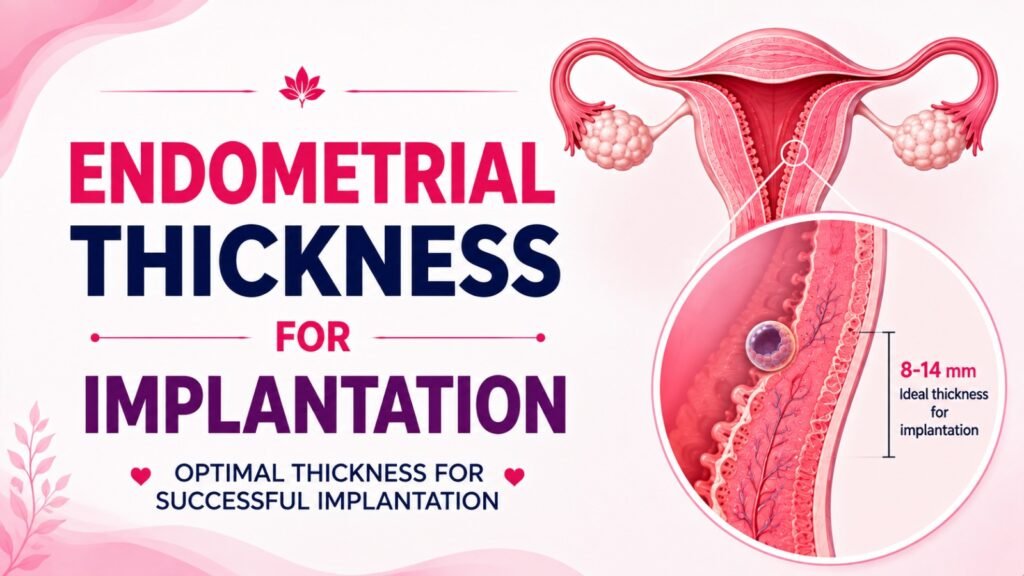
Endometrial Thickness for Implantation
Endometrial thickness is one of the measurements doctors monitor during fertility treatment because the uterine lining plays an important role in embryo implantation. It is usually measured by transvaginal ultrasound and reported in millimeters (mm).
For people undergoing IVF or frozen embryo transfer, an endometrial thickness around 7–12 mm is often considered a favorable range, although there is no single thickness that guarantees successful implantation or pregnancy.
Research increasingly suggests that endometrial thickness should be interpreted as one factor among several rather than as a strict pass-or-fail measurement. A 2025 systematic review and meta-analysis found that thicker endometrium was generally associated with better reproductive outcomes, but the evidence did not support one critical threshold below which embryo transfer should automatically be avoided.
Quick answer
- Below 6 mm: Generally considered a thin lining and may be associated with lower pregnancy or live-birth rates.
- 6–6.9 mm: Pregnancy is still possible, but outcomes may be somewhat less favorable in some IVF populations.
- 7–9 mm: Commonly regarded as a favorable range for embryo transfer.
- 8–12 mm: Frequently associated with good outcomes in IVF studies.
- Above 12 mm: A thicker lining does not automatically mean poor implantation; very thick endometrium should be interpreted in clinical context.
Importantly, these ranges are not guarantees. Successful implantation depends on embryo quality, embryo genetics, maternal age, uterine factors, hormonal preparation, timing, and other reproductive factors.
What Is Endometrial Thickness?
The endometrium is the inner lining of the uterus. During a menstrual cycle, estrogen stimulates this tissue to grow and prepare for a possible pregnancy.
If conception occurs, the embryo must attach to the endometrium during a specific period known as the window of implantation. The lining then supports early pregnancy until the placenta becomes established.
During fertility treatment, ultrasound is commonly used to measure the endometrium. The measurement can change throughout the menstrual cycle, so the timing of the ultrasound matters.
What Is the Ideal Endometrial Thickness for Implantation?
There is no universally accepted “perfect” number.
Historically, 7 mm became a commonly used reference point in assisted reproductive treatment. Earlier research found that clinical pregnancy rates were lower when endometrial thickness was 7 mm or less, although the ability of thickness alone to predict pregnancy was limited.
More recent evidence has made the picture more nuanced.
A 2025 meta-analysis involving 67 studies found a general association between increasing endometrial thickness and better reproductive outcomes. However, the authors concluded that thickness behaves more like a gradient of prognosis than a strict cutoff for deciding whether embryo transfer should occur.
Therefore, instead of asking whether a lining is simply “good” or “bad,” fertility specialists generally consider:
- Endometrial thickness
- Endometrial appearance
- Hormonal environment
- Embryo quality
- Embryo ploidy, when known
- Age and ovarian factors
- Uterine anatomy
- Previous implantation or pregnancy history
- Type of embryo-transfer cycle
Is 7 mm Endometrial Thickness Good for Implantation?
Yes. An endometrial thickness of 7 mm can be adequate for embryo transfer and pregnancy, although some studies associate thicker linings with somewhat higher average live-birth rates.
Importantly, 7 mm should not be viewed as a universal minimum.
A study of 959 single euploid frozen embryo transfers found no clear thickness threshold below which live birth became unlikely. The researchers concluded that routinely cancelling embryo transfer solely because the lining measured less than 7 mm may not be justified, particularly when a euploid embryo is being transferred.
Another study examining more than 7,000 IVF cycles found that apparent differences in live-birth rates between 7–7.9 mm, 8–8.9 mm, and 9–9.9 mm groups disappeared after adjustment for other factors.
This illustrates an important point: 7 mm is a useful clinical reference, not a guarantee or absolute cutoff.
Is 8 mm Endometrial Thickness Good for Implantation?
Yes. An 8 mm endometrium is generally considered favorable for embryo transfer.
Research involving large numbers of IVF cycles has found particularly favorable outcomes in the approximately 8–12 mm range. One large analysis found that live-birth rates increased as the lining became thicker up to approximately 10–12 mm in fresh-transfer cycles, while rates in frozen-transfer cycles tended to plateau around 7–10 mm.
A newer 2025 analysis similarly reported increasing live-birth rates as thickness increased from very thin measurements toward 8 mm and beyond, with continued improvements observed up to approximately 12 mm in its overall population.
However, these are population-level findings. An individual with an 8 mm lining may not necessarily have a better outcome than another patient with a 7 mm lining.
Is 10 mm Endometrial Thickness Good for Implantation?
An endometrial thickness of 10 mm is generally considered a favorable measurement for embryo transfer.
Many IVF studies have reported good pregnancy and live-birth outcomes when the endometrium measures approximately 8–12 mm.
That does not mean implantation becomes substantially more likely simply because the measurement reaches 10 mm. Once the lining is within a favorable range, other factors can become more important.
For example, embryo chromosomal status and embryo developmental potential can have a major influence on implantation and live birth.
Is an Endometrial Thickness Above 12 mm Too Thick?
Not necessarily.
A lining greater than 12 mm does not automatically mean that implantation will fail.
Some older clinical approaches treated very thick endometrium with caution, but contemporary evidence does not establish a universal upper limit at which embryo transfer should be avoided.
A 2022 meta-analysis found no adverse IVF effect from endometrial thickness greater than 14 mm compared with intermediate thickness in the studied population.
The clinical interpretation also depends on why the endometrium is thick. A thick, appropriately developed lining is different from thickening associated with an endometrial polyp, hyperplasia, retained tissue, or another uterine condition.
Therefore, ultrasound appearance and the overall clinical picture matter alongside the measurement.
What Happens If the Endometrium Is Less Than 7 mm?
A thin endometrium can be associated with lower implantation, clinical pregnancy, or live-birth rates in IVF populations.
The association is particularly noticeable at very low measurements. A large analysis of approximately 96,000 autologous embryo transfers found that an endometrium below 6 mm was clearly associated with substantially lower live-birth rates in both fresh and frozen embryo-transfer cycles.
However, a thin lining does not make pregnancy impossible.
This distinction is important because many online resources present 7 mm as an absolute minimum. Current evidence does not support such a simple rule.
The 2025 systematic review found that endometrial thickness is associated with reproductive outcomes but does not provide a single critical threshold that should automatically determine whether embryo transfer proceeds.
What Is a Triple-Line Endometrium?
Endometrial thickness is only one aspect of the uterine lining.
During the late follicular phase, ultrasound may show a characteristic trilaminar or triple-line pattern. This appearance consists of distinct echogenic and hypoechoic layers and is often considered a favorable sign during fertility treatment.
However, the predictive value of endometrial appearance is not absolute.
A patient should not assume that a particular ultrasound pattern guarantees implantation. The embryo and the hormonal environment remain critically important.
Endometrial Thickness in Fresh vs. Frozen Embryo Transfer
The relationship between endometrial thickness and IVF outcomes can differ according to the type of treatment.
Fresh embryo transfer
In fresh IVF cycles, studies have generally found lower live-birth rates with very thin endometrium. Some large datasets show increasing live-birth rates as thickness rises toward approximately 10–12 mm.
Frozen embryo transfer
In frozen embryo transfer cycles, the relationship may be less straightforward.
Some studies have found that live-birth rates increase with thickness up to approximately 7–10 mm and then level off.
Other research, particularly involving euploid embryos, has found no clear threshold at which live birth becomes impossible or dramatically decreases.
This is why fertility specialists generally avoid interpreting an endometrial measurement in isolation.
Does Endometrial Thickness Affect Implantation Rate?
It can, but the relationship is not absolute.
Studies have generally found an association between thinner endometrium and reduced implantation or pregnancy rates, particularly when the lining is very thin. A 2022 meta-analysis found a downward trend in implantation, clinical pregnancy, and live-birth outcomes among fresh IVF cycles with endometrial thickness below 7 mm.
At the same time, the newest evidence indicates that endometrial thickness has limited predictive power when considered alone.
This means that a lining measurement should be interpreted as part of an overall fertility assessment rather than used to predict an individual’s outcome by itself.
What Factors Affect Endometrial Thickness?
Several factors can influence the development of the uterine lining.
1. Estrogen exposure
Estrogen stimulates endometrial proliferation. In hormone-replacement frozen embryo-transfer cycles, estrogen is used to prepare the lining before progesterone is introduced.
2. Uterine conditions
Fibroids, polyps, adhesions, adenomyosis, or previous uterine procedures can affect the endometrium or uterine cavity.
3. Previous uterine surgery
Procedures involving the uterine lining can sometimes contribute to a persistently thin endometrium.
4. Infections or inflammation
Certain uterine conditions may affect endometrial development or receptivity.
5. Hormonal factors
Insufficient estrogen exposure or abnormalities in the hormonal environment may interfere with normal endometrial development.
6. Individual biological variation
Not everyone develops the same endometrial thickness during a fertility cycle. A measurement that is considered “thin” statistically does not necessarily mean that implantation cannot occur.
Can You Increase Endometrial Thickness Naturally?
People undergoing fertility treatment often search for foods, supplements, exercise routines, or home remedies that can increase the uterine lining.
There is no reliably proven natural method that guarantees an increase in endometrial thickness or implantation.
A healthy lifestyle is beneficial for general reproductive health, but patients should be cautious about online claims that a particular food, juice, herb, supplement, or exercise can reliably increase the endometrial lining before embryo transfer.
If the lining repeatedly remains thin, the more useful step is usually to discuss the finding with a fertility specialist and investigate possible underlying causes rather than relying on unproven remedies.
What Can Doctors Do for a Thin Endometrium?
Management depends on the underlying cause and the type of fertility cycle.
A fertility specialist may review:
- The timing and dose of estrogen
- The type of endometrial preparation
- Uterine and endometrial anatomy
- Previous procedures or uterine surgery
- Blood-flow or vascular considerations when clinically appropriate
- The timing of progesterone exposure
- The planned embryo-transfer protocol
- Whether additional evaluation is warranted
Importantly, there is no universally effective treatment for every case of thin endometrium. Treatment should therefore be individualized rather than based on a single protocol promoted online.
Does a Thicker Endometrium Always Mean Better Implantation?
No.
Although many studies show an association between increasing thickness and improved reproductive outcomes, thicker does not automatically mean better for every patient.
The 2025 meta-analysis found a positive association between thickness and reproductive outcomes but emphasized that the evidence quality was frequently low or very low because of bias and inconsistency.
In addition, embryo characteristics can be extremely important.
For example, research involving euploid frozen embryo transfers did not find a clear endometrial-thickness threshold that independently predicted live birth.
Therefore, trying to maximize thickness indefinitely is not necessarily the goal. The objective is an appropriately prepared and healthy endometrium at the correct time for embryo transfer.
Endometrial Thickness and the Window of Implantation
Implantation depends on more than the physical thickness of the endometrium.
The uterus must become receptive during a limited period known as the window of implantation. This process involves hormonal signaling, cellular changes, molecular communication, and synchronization between the embryo and endometrium.
Consequently, two patients with the same endometrial thickness can have different implantation outcomes.
Likewise, a patient with a lining below a commonly quoted threshold can sometimes achieve pregnancy.
This helps explain why modern fertility medicine increasingly treats endometrial thickness as a prognostic factor rather than an absolute implantation test.
Endometrial Thickness by Measurement
| Endometrial thickness | General interpretation in IVF |
|---|---|
| <6 mm | Very thin; often associated with lower reproductive outcomes |
| 6–6.9 mm | Below commonly preferred range, but pregnancy remains possible |
| 7–7.9 mm | Commonly considered acceptable/favorable |
| 8–9.9 mm | Generally favorable |
| 10–12 mm | Commonly associated with favorable outcomes |
| >12 mm | Not automatically abnormal; interpret with ultrasound findings and clinical context |
These categories are general evidence-based ranges, not universal medical cutoffs. Individual fertility clinics may use different protocols.
When Should You Talk to a Fertility Specialist?
Medical advice is particularly important if the endometrium repeatedly measures very thin before embryo transfer, especially when measurements remain below approximately 6–7 mm despite appropriate treatment.
A specialist may consider whether there are underlying uterine, hormonal, or treatment-related factors that need evaluation.
You should also discuss your individual result if you have:
- Repeated failed embryo transfers
- Previous uterine surgery
- Suspected uterine adhesions
- Abnormal uterine bleeding
- Known fibroids or polyps
- Repeatedly thin endometrial measurements
- A significant change in endometrial thickness between treatment cycles
What is the ideal endometrial thickness for implantation?
There is no single ideal measurement that guarantees implantation. In IVF practice, approximately 7–12 mm is commonly regarded as a favorable range, with particularly good outcomes often reported around 8–12 mm. However, successful implantation can occur outside this range.
Is 7 mm enough for embryo implantation?
Yes. A 7 mm lining can support implantation and pregnancy. Although some studies associate thinner linings with lower average success rates, modern evidence does not support treating 7 mm as an absolute minimum.
Is 8 mm a good endometrial thickness for IVF?
Yes. An 8 mm endometrium is generally considered favorable for embryo transfer and falls within the range associated with good outcomes in many IVF studies.
Is 10 mm endometrial thickness good for implantation?
Yes. A 10 mm lining is generally considered favorable. However, increasing thickness beyond this measurement does not guarantee a higher chance of pregnancy.
Can implantation occur with a 6 mm lining?
Yes. Implantation and pregnancy can occur with a 6 mm endometrium, although very thin endometrium is associated with lower average live-birth rates in many IVF populations.
Is 5 mm endometrial thickness enough for IVF?
Pregnancy can occur with a 5 mm lining, but this is considered very thin and is generally associated with less favorable outcomes than a thicker endometrium. Your fertility specialist can determine whether further preparation or investigation is appropriate.
Does a thicker endometrium increase implantation chances?
Generally, research shows an association between increasing thickness and improved reproductive outcomes, particularly when the lining is very thin. However, the relationship is not unlimited, and thickness alone cannot predict implantation.
What is the minimum endometrial thickness for embryo transfer?
There is no universally accepted minimum that applies to every patient. The commonly referenced 7 mm threshold is increasingly viewed as a guideline rather than an absolute cutoff.
Does endometrial thickness matter after embryo transfer?
The measurement used to assess the lining is usually obtained before embryo transfer. Once transfer has occurred, implantation depends on the interaction between the embryo and receptive endometrium rather than on trying to increase the thickness further.
Key Takeaway
The ideal endometrial thickness for implantation is not one exact number.
For IVF and embryo transfer, a lining of approximately 7–12 mm is generally considered favorable, while measurements below 6–7 mm are more often associated with reduced reproductive outcomes. Nevertheless, current evidence shows that there is no universal thickness cutoff that can reliably predict whether implantation will occur.
A 7 mm lining can result in pregnancy, while a 10 or 12 mm lining does not guarantee implantation. The embryo’s quality and genetic status, uterine health, hormonal preparation, timing, age, and other fertility factors all contribute to the final outcome.
The most useful approach is therefore to consider endometrial thickness together with the complete clinical picture, rather than focusing on a single number.
Medical disclaimer: This article is for educational purposes and does not replace individualized advice from a qualified fertility specialist, gynecologist, or reproductive endocrinologist. IVF protocols and decisions about embryo transfer should be based on your medical history and your treating clinician’s assessment.
Visit Vrinda Fertility
Take the next step toward your parenthood journey with expert fertility care, advanced treatments, and personalized treatment plans.
Visit Vrinda Fertility today and consult experienced fertility specialists to understand your fertility needs and explore the right treatment options for you.