
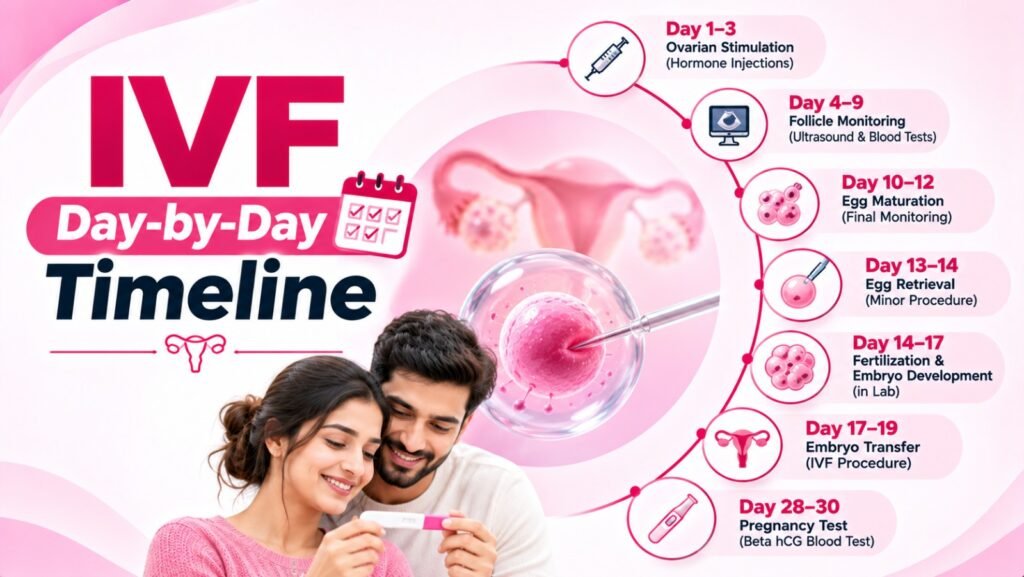
IVF Day-by-Day Timeline
Starting in vitro fertilization (IVF) can bring a mix of hope, excitement, and questions. One of the most common concerns for people preparing for treatment is understanding what happens each day. When do fertility injections begin? How long does egg development take? When is egg retrieval scheduled? How many days after retrieval does embryo transfer happen? And when can you finally take a pregnancy test? Understanding the IVF timeline can make the treatment process easier to navigate. Although every fertility journey is different, most IVF cycles follow a structured sequence of medical appointments, hormone stimulation, egg retrieval, fertilization, embryo development, and embryo transfer. The exact schedule depends on your age, ovarian reserve, hormone levels, response to medication, embryo development, and whether your fertility specialist recommends a fresh or frozen embryo transfer. In this guide, we explain the IVF timeline day by day, describe what happens during each stage, and share practical tips to help you prepare for treatment.What Is the IVF Timeline?
The IVF timeline is the sequence of medical procedures and milestones involved in an IVF treatment cycle. It begins with fertility assessments and treatment planning and continues through ovarian stimulation, egg retrieval, fertilization, embryo development, and embryo transfer. A typical IVF stimulation and retrieval cycle takes approximately two to three weeks from the beginning of stimulation to egg retrieval, although pretreatment and medication protocols can extend this period. If a fresh embryo transfer is appropriate, it usually takes place three or five days after egg retrieval. If embryos are frozen for a later transfer, the overall timeline extends into another treatment cycle. The main stages of the IVF timeline include:- Initial fertility consultation and testing.
- Preparation and medication planning.
- Ovarian stimulation injections.
- Monitoring follicle growth.
- Final egg maturation trigger.
- Egg retrieval.
- Fertilization in the laboratory.
- Embryo development and assessment.
- Fresh or frozen embryo transfer.
- Pregnancy testing and follow-up.
IVF Day-by-Day Timeline: At a Glance
Here is a simplified overview of a common IVF cycle.| IVF Stage | Approximate Timing | What Happens |
|---|---|---|
| Initial consultation | Before treatment | Fertility assessment and treatment planning |
| Baseline assessment | Before stimulation | Ultrasound and blood tests |
| Ovarian stimulation | Days 1–5 | Hormone injections encourage follicle development |
| Continued stimulation | Days 6–10 | Ultrasound and hormone monitoring |
| Final maturation trigger | Often around days 8–14 | Medication prepares eggs for retrieval |
| Egg retrieval | About 34–36 hours after trigger | Eggs are collected from the ovaries |
| Fertilization | Retrieval day | Eggs are inseminated or injected with sperm |
| Early embryo development | Days 1–3 after retrieval | Embryos divide and develop |
| Blastocyst stage | Usually days 5–7 after retrieval | Some embryos develop to the blastocyst stage |
| Fresh embryo transfer | Commonly day 3 or day 5 | An embryo is placed in the uterus |
| Pregnancy test | Usually around 9–14 days after transfer, depending on the protocol | Blood testing checks for pregnancy |
The IVF Timeline Before Treatment Begins
Step 1: Initial Fertility Consultation
Before starting IVF, your fertility specialist will review your medical history, reproductive health, and previous fertility treatments. The consultation may cover:- How long you have been trying to conceive.
- Menstrual cycle regularity.
- Previous pregnancies or miscarriages.
- Medical conditions and medications.
- Previous fertility investigations.
- Semen analysis results, when applicable.
- Previous IVF cycles, if any.
Step 2: Baseline Testing and Treatment Planning
Before ovarian stimulation, your fertility clinic typically assesses your ovaries and hormone levels. Testing may include:- Anti-Müllerian hormone (AMH): Helps estimate ovarian reserve.
- Antral follicle count (AFC): Ultrasound assessment of small follicles in the ovaries.
- Follicle-stimulating hormone (FSH) and estradiol: May be measured to assess ovarian function.
- Transvaginal ultrasound: Evaluates the ovaries and uterus.
- Additional screening: May include infectious disease testing or other investigations required for treatment.
IVF Stimulation Timeline: Day by Day
Ovarian stimulation is one of the most important stages of the IVF timeline. During this phase, fertility medications encourage multiple ovarian follicles to develop during a single menstrual cycle. In a natural menstrual cycle, usually one follicle becomes dominant and releases an egg. IVF medications aim to support the development of multiple follicles so that more than one egg may be available for retrieval. The following schedule describes a common stimulation pattern, although medication doses and treatment duration vary.IVF Day 1: Starting Ovarian Stimulation
The first day of stimulation is the beginning of the active medication phase in many IVF protocols. Your fertility specialist prescribes hormone injections, commonly containing follicle-stimulating hormone (FSH), sometimes combined with luteinizing hormone (LH) activity. These medications encourage ovarian follicles to grow. Depending on the protocol, stimulation may begin on a specific menstrual cycle day or after a period of pretreatment.What might you experience?
Some people feel completely normal during the first few days. Others may notice mild injection-site discomfort or a small amount of bloating. Follow your clinic’s instructions carefully and take medication at the prescribed times.IVF Day 2: Continued Hormone Injections
Stimulation continues as the ovaries respond to the prescribed medications. At this stage, follicles are still developing, and there may be little noticeable change in how you feel. Your fertility team may ask you to maintain a medication schedule and report any missed or delayed doses. It is important not to adjust medication quantities independently, even if you feel that the treatment is progressing slowly.IVF Day 3: Early Follicular Development
By the third day of stimulation, developing follicles may be responding to the hormone injections. However, follicle growth is not always visible through physical symptoms. You cannot reliably determine how many follicles are developing based on bloating, breast tenderness, or other sensations. Your clinic will use ultrasound and, when appropriate, hormone measurements to assess your response. Continue taking medication according to the prescribed plan.IVF Day 4: Ongoing Ovarian Stimulation
The ovaries continue responding to stimulation medication. Some patients begin noticing mild abdominal fullness or tenderness, while others experience no symptoms. There is no single symptom pattern that indicates a successful response. Your fertility specialist may schedule your first monitoring appointment within the next several days, depending on your protocol and initial test results.IVF Day 5: First Monitoring May Be Approaching
Around this point, some clinics perform an ultrasound to assess follicular development. The clinician measures follicles and may order blood tests, particularly estradiol, to evaluate how the ovaries are responding. The results help determine whether medication should continue unchanged or whether adjustments are needed. Not everyone has an ultrasound on day five. Monitoring schedules vary according to the stimulation protocol and the clinic’s assessment.IVF Days 6–7: Follicle Growth and Monitoring
For many patients, monitoring becomes more frequent as stimulation progresses. An ultrasound can show the number and size of developing follicles. Blood tests may provide additional information about the ovarian response. Your fertility specialist may adjust medication doses or introduce another medication to prevent premature ovulation. One commonly used medication group includes GnRH antagonists, which help prevent the body from releasing eggs before the planned retrieval.What happens during this stage?
- Follicles continue growing.
- The clinic evaluates your ovarian response.
- Medication may be adjusted.
- Additional monitoring appointments may be scheduled.
IVF Days 8–10: Continued Stimulation and Closer Monitoring
During this stage, follicles may approach the size associated with final egg maturation. However, not every follicle grows at the same rate, and follicle size does not guarantee that an egg will be retrieved or that the egg will be mature. Your fertility specialist reviews ultrasound findings, hormone levels when measured, and your overall response. Medication may continue for several more days if additional follicular growth is needed.What symptoms are common?
Possible symptoms include:- Mild bloating.
- Pelvic pressure.
- Breast tenderness.
- Fatigue.
- Minor discomfort around injection sites.
IVF Days 11–14: Preparing for the Trigger Injection
Many IVF stimulation cycles reach the final maturation stage somewhere around this period, although some finish earlier or later. Your fertility specialist determines when to administer the trigger injection based on follicle development and other clinical findings. The trigger medication helps the eggs complete the final stages of maturation before retrieval. Common trigger approaches include human chorionic gonadotropin (hCG), a GnRH agonist, or a protocol-specific combination. The choice depends on factors such as the treatment protocol and the risk of ovarian hyperstimulation syndrome (OHSS). The trigger injection must be taken at the exact time prescribed by your clinic. The timing is closely coordinated with egg retrieval, which is generally scheduled approximately 34–36 hours later. Do not change the timing without speaking to your fertility team.Egg Retrieval Timeline
The Trigger Injection: Approximately 34–36 Hours Before Retrieval
The trigger injection marks an important transition in the IVF timeline. Although the eggs have been developing during stimulation, they may not yet be ready for retrieval. The trigger medication supports final maturation. Your clinic will provide specific instructions about the injection, fasting if required, medication adjustments, and the retrieval appointment. Because retrieval timing is carefully coordinated, contact your clinic immediately if you miss the injection or administer it at the wrong time.Egg Retrieval Day: Collecting the Eggs
Egg retrieval is usually performed approximately 34–36 hours after the trigger injection. The procedure is commonly performed under sedation or anesthesia, depending on the clinic and individual circumstances. Using ultrasound guidance, the fertility specialist passes a thin needle through the vaginal wall to reach the ovarian follicles and collect their fluid. The embryology laboratory examines the collected material to identify the eggs.What happens on retrieval day?
The process generally includes:- Arriving at the clinic at the scheduled time.
- Completing pre-procedure checks.
- Receiving sedation or anesthesia, when planned.
- Having the eggs collected using ultrasound guidance.
- Recovering under observation.
- Receiving instructions for aftercare and follow-up.
How many eggs are collected?
The number varies considerably from person to person. Factors include age, ovarian reserve, follicular response, and the treatment protocol. The number of follicles seen on ultrasound does not necessarily equal the number of eggs collected. Not every follicle yields an egg, and not every retrieved egg is mature. Mild cramping, bloating, or light spotting may occur after retrieval. Seek urgent medical advice if you develop severe or worsening abdominal pain, difficulty breathing, fainting, heavy bleeding, persistent vomiting, or rapidly increasing abdominal swelling. These symptoms may require prompt assessment for complications, including ovarian hyperstimulation syndrome.IVF Fertilization Timeline: What Happens in the Laboratory?
Egg Retrieval Day: Fertilization Begins
Once the eggs are collected, the embryology team assesses them and determines the appropriate fertilization method. Two common approaches are conventional IVF and intracytoplasmic sperm injection (ICSI).Conventional IVF
In conventional IVF, prepared sperm are placed with the eggs in laboratory conditions to allow fertilization to occur.ICSI
In ICSI, an embryologist injects a single sperm directly into an egg. ICSI may be recommended in particular situations, including certain cases of male-factor infertility or previous fertilization difficulties. It is not automatically necessary for every IVF cycle. Your fertility specialist and embryology team determine the appropriate approach based on the clinical circumstances.Day 1 After Retrieval: Fertilization Assessment
The embryology laboratory checks whether fertilization has occurred. A normally fertilized egg typically shows two pronuclei, representing the genetic contributions from the egg and sperm. Not every retrieved egg is mature, and not every mature egg fertilizes successfully. This is an important point in the IVF timeline: the number of eggs collected is only one part of the overall picture. The number of normally fertilized eggs provides additional information about the cycle’s progress.Day 2 After Retrieval: Early Embryo Development
Fertilized eggs begin dividing into more cells. The embryology team monitors the developing embryos for their cell number, appearance, and other laboratory characteristics. At this stage, embryos may contain several cells. Development rates differ, and embryos are assessed according to their stage and the laboratory’s established criteria. There is no need to interpret every laboratory update as a prediction of the final outcome. Embryo development provides useful information, but it cannot guarantee implantation or pregnancy.Day 3 After Retrieval: Cleavage-Stage Embryos
By day three, many normally developing embryos have reached the cleavage stage and may contain approximately six to eight cells. Some clinics perform embryo transfers at this stage, depending on the patient’s circumstances and the treatment plan. Other clinics continue embryo culture to the blastocyst stage. The decision depends on factors such as the number and development of embryos, previous treatment history, laboratory practices, and clinical recommendations.Days 4–5 After Retrieval: Morula and Blastocyst Development
Around day four, embryos may develop into a compact structure called a morula. By approximately day five or six, some embryos reach the blastocyst stage. A blastocyst has developed distinct cellular structures, including cells that contribute to the fetus and cells that contribute to the placenta. Not every embryo reaches the blastocyst stage. Some stop developing during laboratory culture, which is one reason the number of embryos may decrease between fertilization and transfer. The embryology team evaluates embryo development and determines which embryos may be suitable for transfer or freezing.Days 5–7 After Retrieval: Embryo Selection and Freezing
Some embryos reach the blastocyst stage on day six or seven rather than day five. Depending on development and laboratory criteria, suitable embryos may be frozen for future use. In selected cases, embryos may undergo preimplantation genetic testing before transfer. This requires additional planning and generally involves freezing embryos while testing is completed. The decision to freeze embryos or proceed with a fresh transfer depends on clinical considerations, embryo development, and the treatment protocol.Embryo Transfer Timeline
Fresh Embryo Transfer: Day 3 or Day 5
A fresh embryo transfer takes place during the same treatment cycle as egg retrieval. It is commonly performed three or five days after retrieval, depending on embryo development and the clinic’s plan. The transfer procedure typically involves placing a selected embryo into the uterus using a thin catheter, often under ultrasound guidance. It generally does not require the same sedation used for egg retrieval.What happens during embryo transfer?
The fertility specialist introduces the catheter through the cervix and places the embryo inside the uterus. The procedure is usually brief. Your clinic may ask you to arrive with a comfortably filled bladder if ultrasound guidance is planned. Afterward, you will receive instructions about medication, activity, and follow-up. The transfer itself does not guarantee implantation. Implantation depends on multiple factors, including embryo characteristics, uterine conditions, and other biological influences.Frozen Embryo Transfer: A Different Timeline
Not every IVF cycle includes a fresh transfer. A frozen embryo transfer (FET) involves transferring an embryo that was frozen during an earlier cycle. A frozen transfer may be recommended when:- The ovaries need time to recover after stimulation.
- There is an increased risk of OHSS.
- Preimplantation genetic testing is planned.
- The uterine lining is not considered suitable for fresh transfer.
- Medical circumstances favor postponing the transfer.
What Happens After Embryo Transfer?
After transfer, the embryo must continue developing and, if conditions permit, implant into the uterine lining. For a blastocyst transfer, implantation may begin within the following few days, but the timing varies. It is important to distinguish embryo transfer from implantation. Transfer is a medical procedure; implantation is a biological process that may or may not follow. You cannot reliably determine whether implantation has occurred based on symptoms alone.The IVF Two-Week Wait: Day by Day
The period between embryo transfer and pregnancy testing is often called the two-week wait. For many patients, this can be one of the most emotionally demanding parts of the IVF timeline. There may be uncertainty, anticipation, and a strong desire to interpret every physical sensation. However, early pregnancy symptoms are not a reliable way to determine whether treatment has worked.Days 1–3 After Transfer: Early Development
Following a blastocyst transfer, the embryo may continue the process of hatching and implantation during the following days. The exact timing varies, and some patients do not experience any noticeable symptoms. Others may notice mild cramping or spotting, which can occur for several reasons. These symptoms cannot confirm implantation or pregnancy. Continue taking prescribed medication as directed.Days 4–6 After Transfer: Implantation May Be Underway
Depending on the embryo’s developmental stage and individual circumstances, implantation may occur during this period or may already have started. If implantation occurs, cells associated with early pregnancy begin producing human chorionic gonadotropin (hCG). However, hCG levels may initially be too low for a reliable pregnancy test. Avoid relying on symptoms, home pregnancy tests, or comparisons with other patients to assess the outcome.Days 7–9 After Transfer: Early Pregnancy Hormone Changes
Some sensitive home pregnancy tests may detect hCG around this time after a blastocyst transfer, but testing too early can produce misleading results. A negative result does not necessarily mean the cycle has failed. The timing of detectable hCG depends on embryo development, implantation timing, the test’s sensitivity, and other factors. If your trigger medication contained hCG, testing too early may also produce a false-positive result because medication-related hCG can remain in the body for a period after administration. Follow your clinic’s recommended testing date.Days 10–12 After Transfer: Pregnancy Testing May Be Approaching
Depending on the clinic’s protocol, a blood pregnancy test may be scheduled around this period or several days later. A blood test measures hCG and can help determine whether pregnancy has occurred. The appropriate testing date depends on whether the embryo was transferred at the cleavage or blastocyst stage, the clinic’s protocol, and individual treatment circumstances. Do not stop progesterone or other prescribed medication because of spotting, cramps, or an early negative home test unless your fertility specialist instructs you to do so.Days 12–14 After Transfer: Beta-hCG Blood Test
Many clinics schedule a beta-hCG blood test approximately 9–14 days after embryo transfer, although the precise interval varies by clinic and transfer stage. This test helps establish whether pregnancy has occurred. If the result is positive, your fertility specialist may repeat the blood test when clinically appropriate and arrange an ultrasound later to assess the pregnancy’s development. If the result is negative, your clinic will advise you about medication, follow-up, and next steps. A positive pregnancy test is an important milestone, but it does not by itself establish the location or ongoing viability of a pregnancy. Ultrasound and clinical follow-up provide further information.Fresh vs. Frozen IVF Timeline: What’s the Difference?
The two approaches share many of the same early steps, but they differ in when embryo transfer takes place.| Treatment Stage | Fresh Embryo Transfer | Frozen Embryo Transfer |
|---|---|---|
| Ovarian stimulation | Required | May occur in an earlier cycle |
| Egg retrieval | Required | Usually completed before the transfer cycle |
| Fertilization | Required | Embryo already created |
| Embryo development | Monitored after retrieval | Embryo developed in an earlier cycle |
| Embryo transfer | Commonly 3 or 5 days after retrieval | Scheduled in a later cycle |
| Uterine preparation | Coordinated with stimulation and retrieval | Natural-cycle monitoring or medication may be used |
| Pregnancy testing | After fresh transfer | After frozen transfer |
What Can Affect Your IVF Timeline?
Although the IVF timeline follows a recognizable pattern, several factors can change the schedule.1. Age and Ovarian Reserve
Age and ovarian reserve can influence the expected response to ovarian stimulation. Some patients develop an appropriate follicular response relatively quickly, while others need a longer stimulation period or a different medication approach. These factors also influence fertility outcomes, although individual results vary.2. Response to Stimulation Medication
The ovaries do not respond identically in every person or every cycle. Your fertility specialist may change medication doses, continue stimulation for additional days, or modify the plan according to ultrasound and blood test results. This flexibility helps the team coordinate egg maturation and retrieval safely.3. Embryo Development
Embryos develop at different rates. Some reach the blastocyst stage by day five, while others develop later. Some embryos stop developing before reaching a stage suitable for transfer or freezing. The embryology team assesses development and recommends the next step based on the available information.4. Fresh Transfer Eligibility
A fresh transfer may not be appropriate in every cycle. For example, a high ovarian response or concern about OHSS may lead your fertility specialist to recommend freezing suitable embryos and postponing transfer. The uterine lining, hormone levels, and other clinical findings may also affect the decision.5. Additional Testing
Preimplantation genetic testing or other laboratory procedures can extend the interval between retrieval and embryo transfer. When genetic testing is planned, embryos are commonly frozen while the results are processed. The clinic will explain how testing affects the schedule.How to Prepare for Each Stage of IVF
A little preparation can make the IVF treatment process easier to manage.Before Stimulation
- Attend recommended fertility assessments.
- Discuss your medication schedule with the clinic.
- Confirm how injections should be stored and administered.
- Ask whom to contact outside regular clinic hours.
- Review any medication or supplement changes with your clinician.
During Stimulation
- Take medications at the prescribed times.
- Attend ultrasound and blood test appointments.
- Follow your fertility specialist’s activity recommendations.
- Keep track of medication doses and appointment dates.
- Contact the clinic if you miss a dose or experience unusual symptoms.
On Egg Retrieval Day
- Follow the clinic’s instructions about fasting and medications.
- Arrange transportation if sedation or anesthesia is used.
- Wear comfortable clothing.
- Plan time to rest afterward.
- Keep the clinic’s emergency contact information available.
After Embryo Transfer
- Continue prescribed progesterone and other medication according to instructions.
- Follow the clinic’s guidance about exercise and daily activities.
- Avoid starting or stopping medicines without medical advice.
- Attend the scheduled pregnancy test.
- Seek medical attention for severe pain, heavy bleeding, fever, breathing difficulties, or other concerning symptoms.
Is the IVF Timeline the Same for Everyone?
No. The IVF timeline differs according to the treatment protocol, ovarian response, embryo development, and transfer strategy. One patient may complete ovarian stimulation in approximately nine days, while another may need longer. One patient may proceed with a fresh blastocyst transfer, while another may have a frozen embryo transfer in a later cycle. These differences do not automatically indicate that one cycle is better or worse than another. The most useful approach is to understand your own treatment milestones and ask your fertility specialist why a particular schedule is recommended. Useful questions to ask include:- When will my stimulation medication begin?
- How often will I need ultrasound monitoring?
- What determines the timing of my trigger injection?
- When is egg retrieval likely to take place?
- Will you recommend a day-three or day-five transfer?
- What circumstances might lead to a frozen transfer?
- When should I take my pregnancy test?
- Which symptoms should prompt an urgent call to the clinic?
Conclusion: Understanding Your IVF Day-by-Day Timeline
The IVF day-by-day timeline provides a helpful overview of what to expect during fertility treatment, from the initial consultation to the pregnancy test. Although the process can seem complicated, each stage has a specific purpose. Fertility assessments help guide treatment planning, ovarian stimulation supports follicular development, egg retrieval collects eggs for laboratory fertilization, and embryo transfer gives a selected embryo the opportunity to implant in the uterus. The overall schedule varies from person to person. Your stimulation may take more or fewer days than expected, embryo development may differ, and your specialist may recommend a frozen transfer rather than a fresh one. Remember that no individual symptom, follicle measurement, egg count, or early pregnancy test can tell the whole story. Your fertility team is best placed to interpret your results and guide your next steps. With a clear understanding of the IVF timeline, regular communication with your fertility specialist, and a treatment plan tailored to your circumstances, you can approach each stage with greater clarity and confidence.Visit Vrinda Fertility
Take the next step toward your parenthood journey with expert fertility care, advanced treatments, and personalized treatment plans. Visit Vrinda Fertility today and consult experienced fertility specialists to understand your fertility needs and explore the right treatment options for you.Visit/Book Your Consultation → Delhi / Noida / Dehradun.
Location By Map – Delhi / Noida / Dehradun .
Frequently Asked Questions (FAQ)
A typical IVF stimulation and egg retrieval cycle takes around two to three weeks from the beginning of stimulation to egg retrieval. A fresh embryo transfer may occur three or five days after retrieval, followed by a pregnancy test approximately 9–14 days after transfer. Frozen embryo transfers may require additional preparation time.
Day 1 of the active IVF treatment cycle often marks the start of ovarian stimulation injections. These medications encourage multiple ovarian follicles to develop. The exact starting day depends on your menstrual cycle and the treatment protocol recommended by your fertility specialist.
IVF stimulation injections commonly continue for approximately 8–14 days, although the duration varies between patients. Your fertility specialist monitors follicle growth through ultrasound scans and, when appropriate, blood tests to determine when the eggs are ready for final maturation.
Egg retrieval typically takes place approximately 34–36 hours after the trigger injection. The exact date depends on follicular development and your fertility specialist’s assessment.