
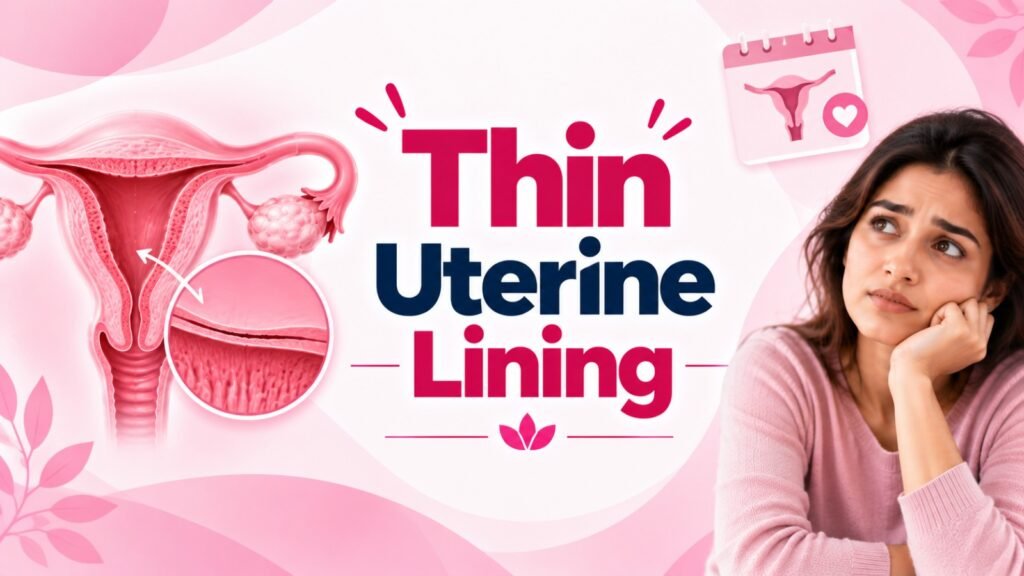
Thin Uterine Lining
A healthy uterine lining, also called the endometrium, plays an important role in embryo implantation. During each menstrual cycle, the endometrium responds to hormones, thickens, develops a characteristic ultrasound appearance, and becomes receptive to an embryo.
When the lining remains unusually thin, particularly during fertility treatment, doctors may describe it as a thin endometrium or thin uterine lining. Research has linked a thin lining with reduced implantation and pregnancy rates in some assisted-reproduction settings, although there is no universally accepted thickness cutoff that applies to every patient or treatment cycle. Studies have used thresholds around 6–8 mm, while some reviews use ≤7 mm.
The good news is that a thin lining is not necessarily a permanent barrier to pregnancy. The most useful approach is to identify the underlying cause, evaluate the uterine cavity when appropriate, and choose treatment based on the individual situation.
What Is a Thin Uterine Lining?
The uterine lining naturally changes throughout the menstrual cycle. It is measured using transvaginal ultrasound, usually at a specific point in the cycle or before embryo transfer.
There is no single universally accepted definition of a “thin” endometrium. Research has commonly used measurements of approximately 6, 7, or 8 mm, depending on the study and clinical setting.
A 2024 review defined thin endometrium as 7 mm or less during the mid-luteal phase and noted its association with lower implantation and clinical pregnancy rates in assisted reproductive treatment.
Importantly, thickness is only one part of endometrial receptivity. The ultrasound pattern, uterine anatomy, hormonal environment, embryo quality, and other fertility factors can also influence the likelihood of implantation.
Does a thin lining always prevent implantation?
No.
A thinner-than-expected lining can be associated with lower pregnancy rates, particularly in IVF or frozen embryo transfer cycles, but it does not mean implantation cannot occur.
This distinction is important because fertility outcomes depend on multiple factors. For example, the embryo’s chromosomal status can have a major influence on implantation and pregnancy. The 2026 ASRM guidance on recurrent implantation failure emphasizes that embryo aneuploidy is an important contributor to implantation failure.
Causes of Thin Uterine Lining
There isn’t one single cause of a thin endometrium. Several factors can contribute.
1. Previous Uterine Procedures
Injury to the endometrium can interfere with normal regeneration.
Examples include:
- Dilation and curettage (D&C)
- Removal of retained pregnancy tissue
- Previous uterine surgery
- Treatment of intrauterine adhesions
- Certain procedures following miscarriage or childbirth
Intrauterine adhesions, sometimes called Asherman’s syndrome, can reduce the amount of functional endometrial tissue.
A history of uterine trauma is particularly important when thin lining develops after a previously normal lining. Recent research has highlighted uterine injury and intrauterine adhesions as important associations with thin endometrium.
2. Intrauterine Adhesions
Scar tissue inside the uterine cavity can prevent the endometrium from developing normally.
Doctors may investigate adhesions using tests such as:
- Transvaginal ultrasound
- Saline infusion sonography
- Hysteroscopy
Hysteroscopy has the additional advantage of allowing certain abnormalities to be treated during the same procedure.
ASRM notes that evaluation of the uterine cavity can identify abnormalities such as polyps, fibroids, adhesions and congenital uterine abnormalities that may affect reproductive outcomes.
3. Hormonal Factors
Estrogen stimulates the proliferative phase of endometrial development.
If estrogen exposure is inadequate or the endometrium does not respond appropriately, the lining may remain thinner than expected.
Hormonal preparation is particularly relevant during some fertility-treatment cycles because the endometrium must be developed and then exposed to progesterone at the appropriate time.
However, simply giving more hormones is not necessarily the solution for everyone. Treatment needs to address the reason the lining is not developing adequately.
4. Certain Fertility Medications
Some ovulation-induction medications can affect endometrial development.
For example, the literature has associated clomiphene citrate and some other fertility-treatment protocols with reduced endometrial thickness in certain patients. The 2024 review also identifies long-term oral contraceptive use and ovulation-promoting medications among factors associated with endometrial thinning.
A fertility specialist may therefore consider whether changing the stimulation or endometrial-preparation protocol is appropriate.
5. Uterine or Endometrial Inflammation
Chronic inflammation may interfere with normal endometrial function.
Conditions such as chronic endometritis can sometimes be considered when there is recurrent implantation failure or other clinical indications.
Importantly, testing should be individualized rather than performed indiscriminately. The 2026 ASRM recurrent implantation failure guidance supports evaluation for certain structural and inflammatory factors when recurrent implantation failure is suspected.
6. Reduced Uterine Blood Flow
Adequate blood supply is important for tissue development.
Research into thin endometrium has identified impaired uterine perfusion and abnormal angiogenesis as possible mechanisms. However, the biological mechanisms are complex, and measuring blood flow does not automatically identify a treatment that will improve live-birth rates.
7. Endometriosis or Adenomyosis
Endometriosis and adenomyosis may affect the uterine environment and implantation.
These conditions do not necessarily cause a thin lining in every patient, but they may be relevant when thin endometrium occurs alongside infertility, pelvic symptoms, or repeated implantation failure.
8. Sometimes No Clear Cause Is Found
Despite investigation, some women have persistently thin endometrium without an obvious explanation.
This is sometimes called idiopathic thin endometrium.
In these situations, treatment may focus on optimizing the fertility-treatment protocol and addressing potentially modifiable factors rather than searching indefinitely for a single explanation.
How Is Thin Uterine Lining Diagnosed?
The primary test is generally transvaginal ultrasound.
The clinician may assess:
- Endometrial thickness
- Endometrial pattern
- Uterine anatomy
- Follicular development
- Ovaries
- Other pelvic structures
The timing of the measurement matters because the endometrium changes substantially throughout the menstrual cycle.
If the lining repeatedly remains thin, particularly before an embryo transfer, additional evaluation may be considered.
Possible investigations include:
Saline infusion sonography: Helps evaluate the inside of the uterine cavity.
Hysteroscopy: Allows direct visualization of the uterine cavity and can identify or treat some abnormalities.
Hormonal assessment: May be appropriate when menstrual or ovulatory abnormalities suggest an endocrine problem.
Assessment for chronic endometritis: May be considered in selected patients, particularly with recurrent implantation failure.
ASRM recommends a systematic infertility evaluation rather than relying on a single test, with uterine imaging playing an important role when indicated.
Thin Uterine Lining and Implantation
Implantation is a highly coordinated process.
After fertilization, the developing embryo reaches the blastocyst stage and interacts with the endometrium. Implantation begins approximately 5–7 days after fertilization.
For implantation to occur successfully, the endometrium needs to undergo appropriate hormonal and cellular changes.
A thin endometrium may reflect:
- Insufficient tissue development
- Altered vascularization
- Abnormal cellular signaling
- Inflammation
- Scarring or adhesions
- Impaired decidualization
- Other changes affecting endometrial receptivity
However, it is important not to equate thin lining with failed implantation. Implantation depends on the interaction between embryo and endometrium, and embryo quality remains a critical factor.
Treatment for Thin Uterine Lining
Treatment should be individualized. There is currently no single therapy guaranteed to thicken the endometrium or increase live-birth rates in every patient.
1. Optimize Estrogen Preparation
When appropriate, fertility specialists may adjust the estrogen component of an endometrial-preparation cycle.
Depending on the patient’s circumstances, clinicians may modify:
- Dose
- Duration
- Route of administration
- Timing of progesterone
- Overall treatment protocol
The objective isn’t simply to achieve a particular number on ultrasound. The goal is to create an appropriately developed and hormonally synchronized endometrium.
2. Change the Fertility Treatment Protocol
If a thin lining repeatedly occurs during one type of cycle, a fertility specialist may consider another approach.
For example, the clinician may assess whether a different ovulation-induction or embryo-transfer protocol could produce a better endometrial response.
This decision depends on ovarian function, ovulation, previous treatment response and the reason for assisted reproduction.
3. Treat Intrauterine Adhesions
If scar tissue is responsible for poor endometrial development, hysteroscopic treatment may be appropriate.
Treating the underlying structural problem is generally more logical than repeatedly adding medications without addressing the cause.
4. Treat Underlying Uterine Disease
If imaging identifies a relevant structural abnormality, treatment may focus on the abnormality itself.
Depending on the diagnosis, this can include management of:
- Intrauterine adhesions
- Endometrial polyps
- Submucosal fibroids
- Congenital uterine abnormalities
- Hydrosalpinx
The appropriate intervention depends on the specific condition and reproductive history.
PRP for Thin Endometrium: Does It Work?
Platelet-rich plasma (PRP) has attracted considerable interest as a possible treatment for thin endometrium.
The proposed mechanism is that growth factors released from platelets could potentially support tissue regeneration, vascular development and endometrial repair.
Some studies have reported improvements in endometrial thickness or pregnancy-related outcomes. However, evidence remains inconsistent, and studies differ substantially in patient selection, PRP preparation, dosage and timing.
The 2026 ASRM committee opinion states that there is currently insufficient evidence to support intrauterine PRP routinely for recurrent implantation failure, despite promising findings in some studies involving thin endometrium.
Therefore, PRP should be considered an emerging or investigational option, rather than a universally established treatment.
What About G-CSF?
Granulocyte colony-stimulating factor, or G-CSF, has also been investigated for thin endometrium.
Some research has suggested that G-CSF may increase endometrial thickness or improve implantation-related outcomes in selected patients. However, the evidence is heterogeneous.
ASRM’s current recurrent implantation failure guidance does not recommend G-CSF routinely because sufficient evidence demonstrating improved live-birth rates is lacking.
This is an important distinction: a treatment can increase endometrial thickness without necessarily proving that it increases the chance of taking home a baby.
Supplements, Acupuncture and Other Natural Treatments
Patients are often advised to try supplements, acupuncture, dietary changes or circulation-enhancing approaches.
Some complementary approaches have been studied, but evidence varies considerably.
The 2024 review of thin endometrium describes hormonal, vasoactive, regenerative and complementary approaches, while also emphasizing that mechanisms and clinical effectiveness remain uncertain for several newer therapies.
A sensible approach is to focus on overall reproductive health:
- Eat a balanced diet.
- Avoid smoking.
- Maintain a healthy weight.
- Exercise regularly at an appropriate level.
- Correct documented nutritional deficiencies.
- Manage medical conditions appropriately.
- Follow prescribed fertility medications carefully.
- Avoid starting supplements or medications solely because they are marketed as “endometrial boosters.”
There is currently no food that has been proven to reliably increase endometrial thickness enough to improve implantation.
Can You Get Pregnant With a Thin Uterine Lining?
Yes, pregnancy can still occur with a thin uterine lining.
A thin measurement may reduce the probability of implantation in some fertility-treatment settings, but it does not make pregnancy impossible.
Doctors also consider:
- Age
- Embryo quality
- Embryo chromosomal status
- Ovulation
- Sperm factors
- Uterine anatomy
- Endometrial pattern
- Previous pregnancy history
- Underlying medical conditions
Consequently, treatment decisions should not be based on endometrial thickness alone.
When Should You See a Fertility Specialist?
Consider discussing evaluation with a fertility specialist if:
- Your endometrium repeatedly measures below the range expected by your clinic.
- Your lining remains thin during IVF or frozen embryo transfer cycles.
- You have had repeated implantation failure.
- You previously underwent D&C or another uterine procedure.
- Your periods became unusually light after a uterine procedure.
- You have irregular or absent periods.
- You have known endometriosis or adenomyosis.
- You have experienced recurrent pregnancy loss.
- You have been trying to conceive without success.
ASRM generally recommends infertility evaluation after 12 months of trying in women under 35 and after 6 months in women 35 or older, with earlier evaluation appropriate when there are known risk factors for infertility.
Key Takeaways
A thin uterine lining can be an important consideration when trying to conceive, particularly during IVF or frozen embryo transfer. However, it is only one component of reproductive success.
The most important steps are:
- Confirm the measurement at the appropriate point in the cycle.
- Look for an underlying cause rather than treating the measurement alone.
- Evaluate the uterine cavity when clinically indicated.
- Address adhesions, polyps, fibroids or other relevant abnormalities.
- Optimize hormonal and fertility-treatment protocols when appropriate.
- Be cautious with experimental treatments such as PRP and G-CSF.
- Consider embryo quality and other fertility factors alongside endometrial thickness.
Current evidence supports an individualized approach rather than a one-size-fits-all “lining thickness” treatment. New therapies are being investigated, but several popular interventions still require better-quality trials before their effect on live birth can be established.
Conclusion
A thin uterine lining can be frustrating, especially when preparing for pregnancy or embryo transfer, but it does not automatically mean that implantation or pregnancy is impossible. The key is determining why the endometrium is thin and whether a correctable uterine, hormonal or treatment-related factor is present.
Working with a qualified gynecologist or reproductive endocrinologist can help distinguish between a temporary treatment-related finding and a persistent endometrial problem. Rather than focusing solely on achieving a specific thickness, modern fertility care considers the uterine cavity, endometrial development, hormonal synchronization and embryo-related factors together.
For persistent thin lining or repeated implantation failure, evidence-based evaluation is generally more valuable than trying multiple unproven “lining boosters” on your own.
Visit Vrinda Fertility
Take the next step toward your parenthood journey with expert fertility care, advanced treatments, and personalized treatment plans.
At Vrinda Fertility, experienced fertility specialists provide comprehensive care tailored to your individual fertility needs. Whether you are considering IVF, IUI, ICSI, fertility preservation, or other advanced fertility treatments, our team is here to guide you at every step.